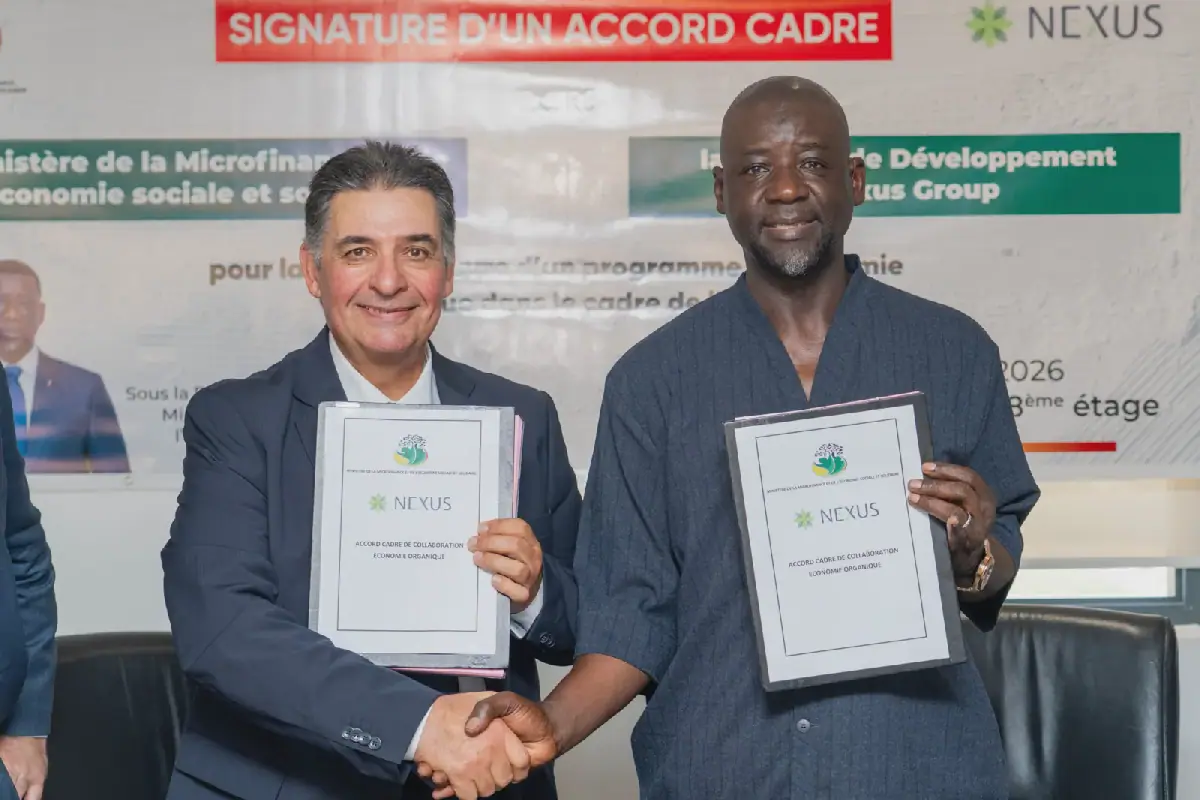
The Senegalese government has taken a significant step towards transforming its economy by signing a strategic partnership with the Nexus Group on October 26, 2026. The agreement, which marks a historic milestone, aims to implement the country's first organic economy program. The partnership was signed by the Minister of Microfinance and Social and Solidarity Economy, Dr. Alioune Badara Dione, and representatives from the Nexus Group. This initiative is expected to play a crucial role in Senegal's economic development.
According to Dr. Alioune Badara Dione, the organic economy program is designed to align with the country's Vision Senegal 2050, which seeks to build a sovereign, endogenous, just, and sustainable economy. The minister emphasized that this new economic model will be based on the principles of social and solidarity economy, differing significantly from traditional economic approaches. He described the organic economy as a model that functions like a living organism, where resources are utilized efficiently and waste is minimized.
The organic economy program will focus on four key projects, including the creation of Senegal's first model mining village. This project aims to move beyond the traditional extraction and export of raw materials, instead promoting local transformation and value creation. The minister expressed his confidence in the partnership with Nexus Group, assuring them of a secure, transparent, and mutually beneficial environment for the program's implementation.
Sandro Vincenzi, representing the Nexus Group, welcomed the partnership and expressed his hope that it would yield concrete results. He emphasized that this collaboration would not only benefit Senegal but also serve as a model for other countries in Africa. Vincenzi highlighted the significance of this partnership, stating that it would mark a visible milestone in Senegal's modern economic history.
The partnership between Senegal and Nexus Group aims to promote an economic model that values local resources, structural transformation, and social and solidarity economy principles. This initiative is expected to have a positive impact on Senegal's economic development and serve as a model for sustainable economic growth. The program's success will depend on effective collaboration between the government and the Nexus Group.
The signing of this agreement demonstrates Senegal's commitment to diversifying its economy and promoting sustainable development. The country's Vision Senegal 2050 emphasizes the need for a more equitable and sustainable economic model, and this partnership with Nexus Group is a significant step towards achieving this goal. The program's focus on local transformation and value creation is expected to have a positive impact on the country's economic growth.
The implementation of Senegal's first organic economy program is expected to have far-reaching consequences for the country's economic development. With the support of the Nexus Group, Senegal aims to create a more sustainable and equitable economy that benefits its citizens. The success of this program will depend on effective collaboration between the government, the private sector, and civil society.
Key points
- The partnership aims to promote a model economic based on local resource valorization and social and solidarity economy principles.
- The program includes four key projects, including the creation of Senegal's first model mining village.
- The initiative aligns with Senegal's Vision Senegal 2050, which seeks to build a sovereign, endogenous, just, and sustainable economy.