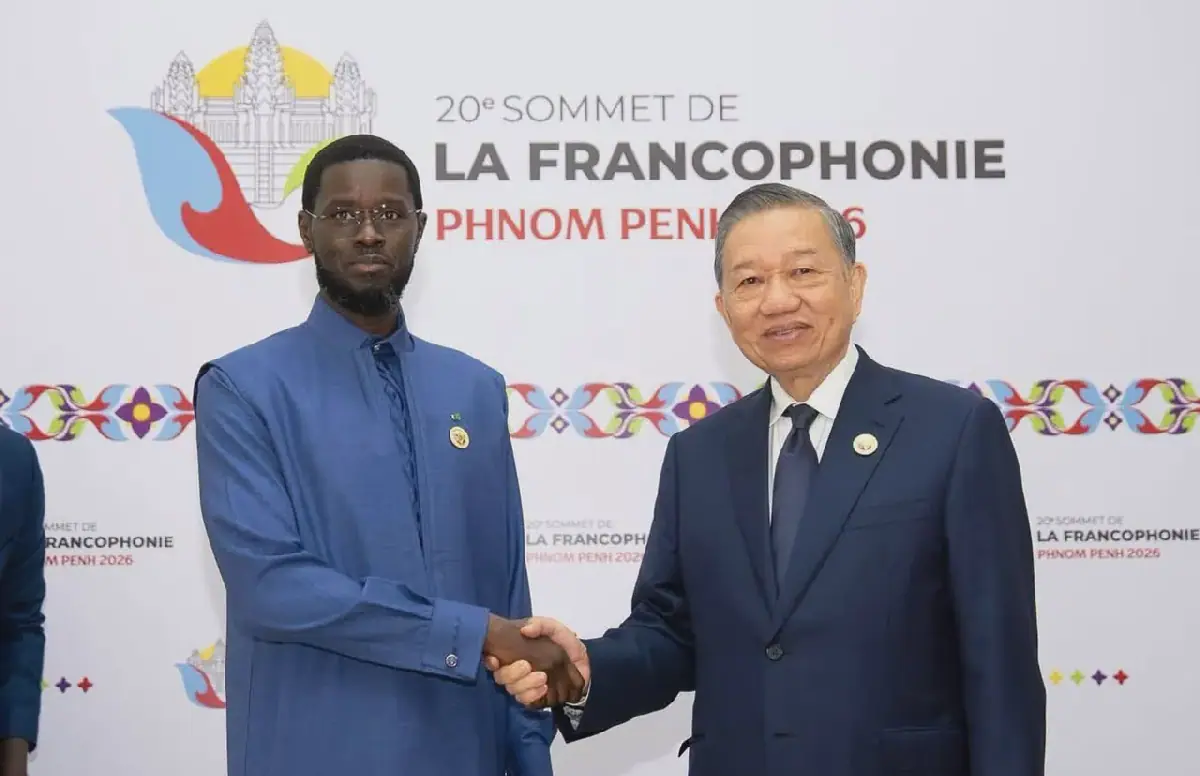
Senegalese President Bassirou Diomaye Faye and Vietnam's General Secretary and President To Lam met in Phnom Penh, Cambodia, on the sidelines of the 20th Francophonie Summit. They discussed ways to strengthen economic ties between the two countries, focusing on cooperation in rice production, cashew farming, infrastructure, and investment. The meeting aimed to turn longstanding diplomatic relationships into practical business opportunities for companies in Africa and Asia.
Agriculture was a major focus of the discussions, particularly the development of rice and cashew production. To Lam proposed mobilizing domestic and international resources for joint agricultural projects and implementing existing agreements between the two countries. This cooperation is significant for Senegal's food security ambitions, as the country heavily relies on rice imports to meet domestic demand. In 2026, Senegal was projected to import 1.5 million tonnes of rice, equivalent to approximately 70 percent of its domestic demand.
Vietnam has an established position in the international rice trade, and its commercial relationship with Senegal has already expanded. In 2025, Vietnamese rice exports to Senegal reached 168,020 tonnes, worth approximately $52.57 million. This existing commercial foundation provides a basis for the two governments to build broader agricultural cooperation. The discussions also explored opportunities for joint investment and the exchange of expertise, potentially creating room for cooperation in production and other parts of the food supply chain.
The two countries see an opportunity to use their geographical positions to reach wider markets. Vietnam could serve as an entry point for Senegalese businesses seeking opportunities in the Association of Southeast Asian Nations (ASEAN), while Senegal could provide Vietnamese companies with access to the Economic Community of West African States (ECOWAS). Faye welcomed the proposals and described Vietnam as a development model, expressing his determination to make relations between the two countries an example of cooperation between Africa and Asia.
Beyond agriculture, the two leaders identified energy, telecommunications, digital technology, mining, and infrastructure construction as additional areas for business cooperation. They agreed to encourage companies from both countries to explore investment opportunities and strengthen the implementation of existing agreements. Faye also pledged to facilitate investment by Vietnamese companies through information on potential projects and available investment incentives.
The historical relationship between the two countries was another important part of the discussions. To Lam recalled that 115 years ago, Vietnamese revolutionary leader Ho Chi Minh visited the port of Dakar and stood alongside African political activists, including Senegalese revolutionaries, during the struggle against colonialism. Faye also held discussions with Quebec Premier Paul St-Pierre Plamondon, focusing on the relationship between Senegal and Quebec, shared positions on issues of mutual interest, and opportunities to expand bilateral trade.
The meetings reflect Senegal's efforts to diversify its international partnerships, particularly with countries and economies that can contribute to its economic development. The next important test for the Senegal-Vietnam relationship will be whether the commitments made in Phnom Penh lead to concrete agricultural projects, greater investment, and stronger commercial links between the two regions. The outcome will be crucial in determining the future of cooperation between the two countries.
Key points
- Senegal and Vietnam discuss expanding economic ties in agriculture, infrastructure, and investment.
- The two countries aim to strengthen cooperation in rice production, cashew farming, and other areas.
- The discussions also explored opportunities for joint investment and the exchange of expertise between Senegal and Vietnam.