The Court of Arbitration for Sport (CAS) will examine the appeal of the Senegalese Football Federation (FSF) against the Confederation of African Football's (CAF) decision to award Morocco the 2025 Africa Cup of Nations (CAN-2025) title on a 3-0 forfeit. The hearing, scheduled for Thursday, October 7, 2026, in Lausanne, Switzerland, will be held behind closed doors. The CAS panel, comprising French, Italian, and German arbitrators, will listen to representatives from the FSF, the Royal Moroccan Football Federation (FRMF), and the CAF.
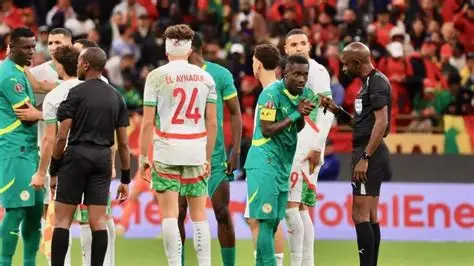
The controversy surrounding the CAN-2025 final began on January 18, 2026, when Senegal defeated Morocco 1-0 in extra time. However, the match was marred by controversy, with Senegalese players leaving the field in protest over a penalty awarded to Morocco. The CAF's appeal committee later ruled that Senegal had forfeited the match due to their failure to complete the game, citing articles 82 and 84 of the CAN regulations.
The Senegalese Football Federation has denounced the CAF's decision as a "gross administrative robbery" and has retained the trophy, presenting it to their diaspora supporters in France. By taking their case to the CAS, Senegal aims to reclaim the African championship title and challenge the CAF's authority. Sports law expert Thibault Ulrich notes that the CAF's interpretation of the CAN regulations is overly strict and disregards the fact that the match referee allowed the game to resume after Senegal's return.
The "Law of the Game" and the International Board's regulations state that referees' decisions on game-related matters are final and binding. The CAS has consistently upheld the "doctrine of the playing field," which holds that referees' decisions cannot be overturned unless there is evidence of corruption or bad faith. This doctrine prioritizes preserving the integrity of competitions and ensuring that results are determined on the field, rather than through post-hoc judicial intervention.
In a related development, the Senegalese government has called for an international investigation into allegations of corruption within the CAF's governing bodies. The CAF has responded by emphasizing the independence of its disciplinary bodies. Notably, the CAF had recently dismissed Yassin Osman Robleh, a jurist responsible for ensuring the integrity of its procedures, without explanation.
The CAS hearing will not result in an immediate decision, but the panel will begin deliberations following the hearing. A ruling is expected in the near future, potentially resolving a dispute that has been ongoing for several months. The outcome will have significant implications for the principles of sports governance and the authority of referees.
The dispute between Senegal and Morocco has sparked a broader debate about the role of governing bodies in African football and the consistency of their decision-making processes. As the CAS considers the appeal, football stakeholders across the continent will be watching closely for a resolution that could set a precedent for future cases.
Key points
- The Court of Arbitration for Sport will hear Senegal's appeal against Morocco's CAN-2025 title win.
- The CAF's decision to award Morocco the title was based on Senegal's failure to complete the match.
- The Senegalese government has alleged corruption within the CAF's governing bodies.