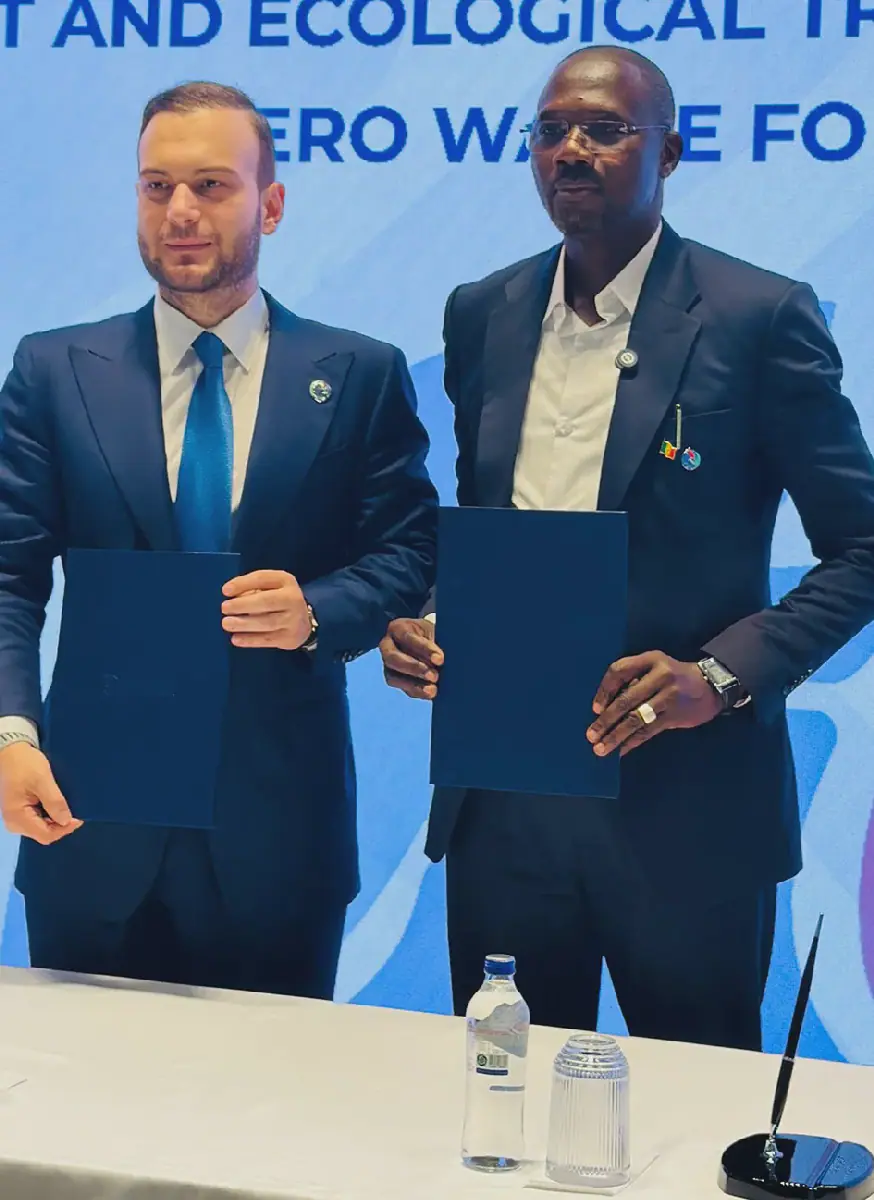
Senegal's Minister of Environment and Ecological Transition, Dr. Aliou Gori Diouf, has signed a strategic partnership with the Zero Waste Foundation during the Cop31 conference in Antalya, Turkey. The goal is to accelerate the implementation of Senegal's "Zero Waste" initiative, inspired by Turkey's successful "Sıfır Atık" program. Turkey has increased its municipal waste recycling rate from 13% in 2017 to 37.53% in 2025.
The Turkish model has achieved significant results, with targets to reach 60% recycling by 2035 and 70% by 2053. Senegal aims to replicate this success, addressing its own waste management challenges. The country produces around 2.46 million tons of solid waste annually, with 58% coming from the Dakar region. Additionally, over 250,000 tons of plastic waste are generated each year, with only 10% being recycled.
Despite existing initiatives, such as the 2020 law on plastic product environmental impact and the creation of the National Waste Management Company (Sonaged), waste management in Senegal remains hindered by coordination and valuation issues. The new initiative seeks to shift from a focus on waste collection and elimination to a circular economy approach. The transformation of the Mbeubeuss landfill into a sorting center and urban park is a key symbol of this new direction.
Dr. Aliou Gori Diouf plans to draw on Turkey's experience to implement a national strategy based on five axes: strengthening the legal framework, promoting public administration exemplarity, developing treatment and recycling infrastructure, mobilizing citizens, and establishing sustainable financing mechanisms. Measures include compulsory waste sorting in public buildings, certification systems, composting, and micro-recycling units.
The program will be implemented in three phases from 2027 to 2035. The first year will focus on launching the initiative, adopting the application decree, and equipment installation. The program will then be extended to major waste producers and regional sectors. By 2031-2035, compulsory sorting is expected to be generalized to households, alongside the closure of Mbeubeuss and development of energy valorization.
At the Cop31 conference, Dr. Aliou Gori Diouf also advocated for greater female leadership in the green transition in West Africa. He emphasized that women are essential actors in the transition, with a crucial role in agriculture, food security, and natural resource management. The Senegalese government has launched initiatives, including a National Gender and Climate Change Strategy and a guide for integrating gender into adaptation planning.
The Cedeao regional program, supported by the UN Women, aims to promote women's leadership in the green transition. The program plans to support 30 gender-sensitive reforms, establish 15 adapted financing mechanisms, and mobilize nearly $70 million in private financing for women's green activities. Dr. Aliou Gori Diouf outlined priorities, including facilitating women's access to financing, securing land rights, and strengthening their competences.
Key points
- Senegal partners with Turkey's Zero Waste Foundation to boost recycling and waste management
- The country aims to increase its recycling rate to 25% by 2030 and 40% by 2035
- Dr. Aliou Gori Diouf advocates for greater female leadership in the green transition in West Africa