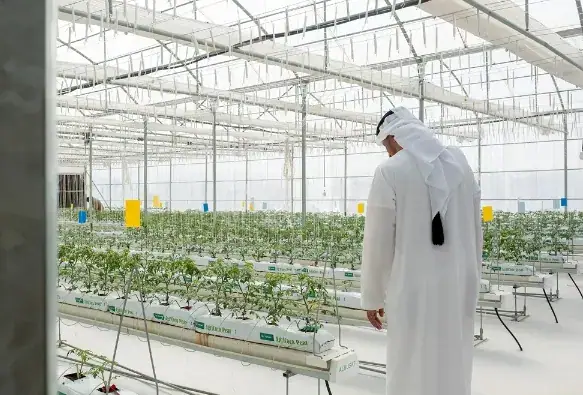
A team of scientists from 20 countries has gathered in the United Arab Emirates to explore the possibility of growing tomatoes in desert conditions. The researchers are testing technologies to cultivate tomatoes, cucumbers, melons, and berries in an environment with extreme temperatures and salty groundwater. The UAE desert presents a challenging environment, with temperatures often exceeding 50°C and rainfall occurring only once a year.
The scientists are working at a $200 million farming-tech incubator in the UAE, aiming to make desert farming commercially viable. The facility provides a controlled environment for the researchers to experiment with various techniques and technologies. The goal is to develop sustainable farming methods that can be applied in similar environments around the world.
The UAE's desert environment poses significant challenges for farming. The soil is largely sand, and the groundwater is salty, making it difficult to grow crops. The team's experiments focus on finding solutions to these challenges, such as developing irrigation systems and selecting crop varieties that can thrive in these conditions.
The project has the potential to increase food production in regions with limited agricultural resources. By developing technologies for desert farming, the researchers hope to improve food security and support sustainable development. The team's findings could also be applied to other areas with similar environmental conditions.
The international team of scientists brings together experts from various fields, including agriculture, engineering, and environmental science. Their collaboration allows for a comprehensive approach to addressing the challenges of desert farming. The researchers are working together to share knowledge and expertise, increasing the chances of success.
The experiment is a significant step towards achieving sustainable food production in arid regions. The team's work could pave the way for large-scale desert farming projects, providing a new source of income for local communities. The project's success could also inspire similar initiatives in other parts of the world.
The scientists' efforts to develop desert farming technologies have garnered attention from various stakeholders, including governments, farmers, and investors. The project's outcomes could have a significant impact on the future of agriculture in regions with limited resources. As the team continues to experiment and refine their techniques, their findings will be closely watched by those interested in sustainable development and food security.
Key points
- International team experiments with growing tomatoes in UAE desert conditions
- Project aims to make desert farming commercially viable
- Findings could improve food security and support sustainable development