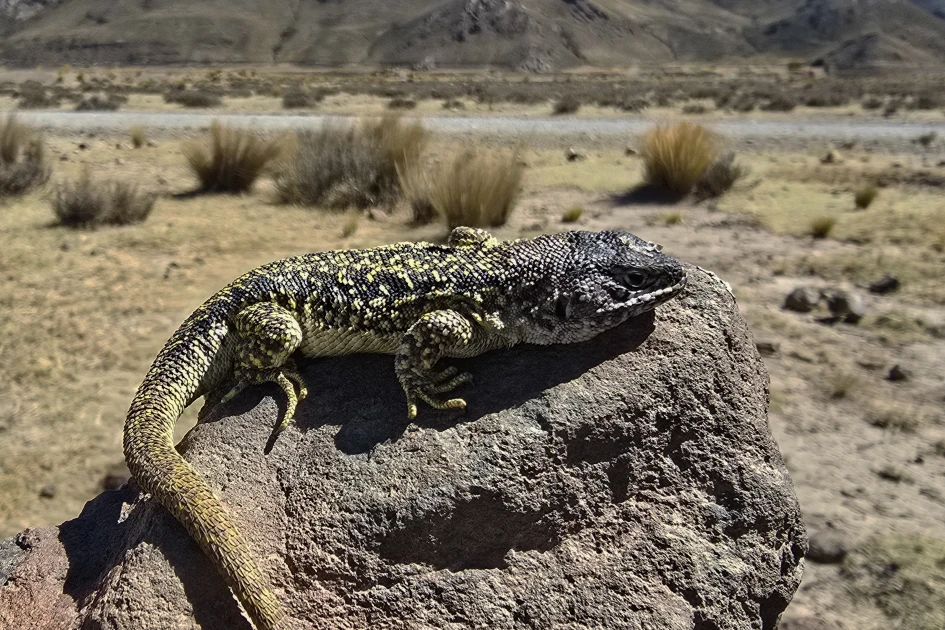
A new species of lizard has been discovered in the Peruvian Andes by a team of scientists from the Natural History Museum of San Marcos University. The lizard, named Liolaemus archipensis, was found at an altitude of over 4,800 meters in the southern Andean region of Arequipa. This region is known for its unique biodiversity, and the discovery is considered a significant advance for the field.
The Liolaemus archipensis measures between 6 and 8 centimeters in length, and exhibits distinct coloration depending on sex. Females have square-shaped spots on their backs, while males have oblique spots and white scales that help them blend into their rocky surroundings. This unique coloration is an adaptation to their environment, allowing them to camouflage and protect themselves from predators.
The new species of lizard feeds on plants and small arthropods, including spiders, beetles, true bugs, and insect larvae. This diet is typical of many lizard species, but the Liolaemus archipensis has adapted to the specific conditions of its high-altitude habitat. The discovery of this new species highlights the rich biodiversity of Peru, a country home to 296 species of lizard.
The research team, led by biologist Ling Huamani-Valderrama, published their findings in the Swiss scientific journal Diversity. The discovery of the Liolaemus archipensis is a significant contribution to the field of biology, and sheds new light on the biodiversity of the Peruvian Andes. The team used advanced techniques to study the lizard's morphology, genetics, and ecology.
According to biologist Ling Huamani-Valderrama, the description of a new species represents a very important advance for biodiversity in Peru. The discovery highlights the importance of continued research and exploration of the country's natural habitats, which are home to many unique and endemic species. The Liolaemus archipensis is an important addition to Peru's biodiversity, and will be the subject of further study.
The Liolaemus archipensis is a remarkable example of adaptation to high-altitude environments. The lizard's unique coloration, diet, and morphology have allowed it to thrive in one of the most inhospitable regions of the Andes. Further research on this species will provide valuable insights into the evolution of high-altitude adaptations, and the biodiversity of the Peruvian Andes.
The discovery of the Liolaemus archipensis is a testament to the importance of scientific research and exploration. The finding highlights the need for continued investment in scientific research, particularly in regions with high biodiversity like the Peruvian Andes. The research team's findings have significant implications for our understanding of biodiversity, and will contribute to conservation efforts in the region.
Key points
- The new species of lizard, Liolaemus archipensis, was discovered at an altitude of over 4,800 meters in the southern Andean region of Arequipa.
- The lizard measures between 6 and 8 centimeters in length, and exhibits distinct coloration depending on sex.
- The discovery of the Liolaemus archipensis is a significant contribution to the field of biology, and sheds new light on the biodiversity of the Peruvian Andes.