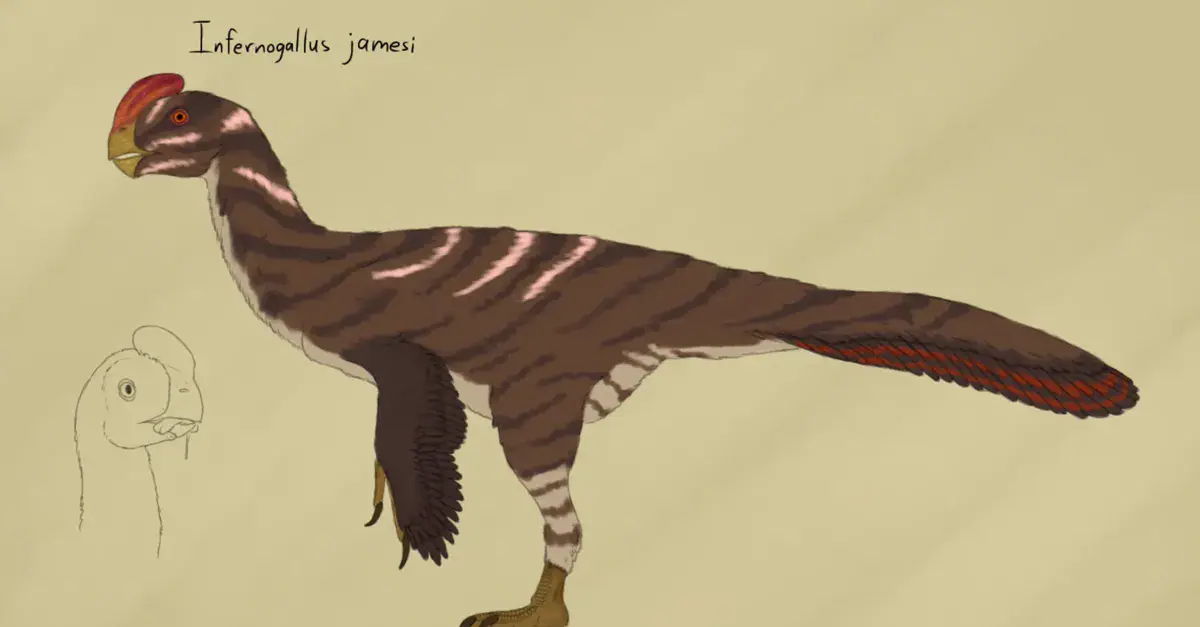
A team of scientists has identified a previously unknown species of dinosaur that lived around 66 million years ago during the Cretaceous period. The dinosaur, named Inferonogalus jamesi, was about the size of a turkey and had a distinctive beak-like head similar to a parrot. Its fossil remains were discovered in the Hell Creek formation, a renowned fossil site in the US states of Montana and North Dakota.
Inferonogalus jamesi, which translates to "hell's chicken," had several unique features that set it apart from other known dinosaurs. Its jaw and teeth were specially adapted to crush and eat soft plant material, such as fruit. The dinosaur's skull and jaw structure suggest that it was able to move its jaw in a way that allowed it to grind and mash its food, similar to some modern birds.
According to the researchers, Inferonogalus jamesi had a number of specialized features that indicate it was a fruit-eater. These included a distinctive beak with a series of ridges and pits that would have helped to crush and grind plant material. The dinosaur's jaw was also highly mobile, allowing it to move forward and backward in a way that would have enabled it to eat a wide range of soft plant foods.
The discovery of Inferonogalus jamesi provides new insights into the diversity of dinosaur diets and challenges previous assumptions about what these prehistoric creatures ate. While many dinosaurs are known to have been herbivores or carnivores, this is the first time that a dinosaur has been found with clear evidence of a fruit-based diet.
Inferonogalus jamesi lived in a coastal floodplain ecosystem during the Late Cretaceous period, where it would have coexisted with other iconic dinosaurs such as the Tyrannosaurus rex and Triceratops. The dinosaur's environment was likely warm and humid, with abundant vegetation and possibly fruiting plants.
The fossil remains of Inferonogalus jamesi were discovered in the Hell Creek formation, a famous fossil site that has yielded many important discoveries. The formation dates back to the Late Cretaceous period and has produced fossils of many well-known dinosaurs, including the Tyrannosaurus rex and Velociraptor.
The study's findings have significant implications for our understanding of dinosaur evolution and diversity. According to Dr. Thomas Dudgeon, co-author of the study, "Previously, it had been suggested that some groups of dinosaurs may have eaten fruit, but there was never any concrete evidence to support this."
Key points
- The discovery of Inferonogalus jamesi provides new insights into the diversity of dinosaur diets and challenges previous assumptions about what these prehistoric creatures ate.
- Inferonogalus jamesi had several unique features that indicate it was a fruit-eater, including a specialized beak and jaw structure.
- The fossil remains of Inferonogalus jamesi were discovered in the Hell Creek formation, a renowned fossil site in the US states of Montana and North Dakota.