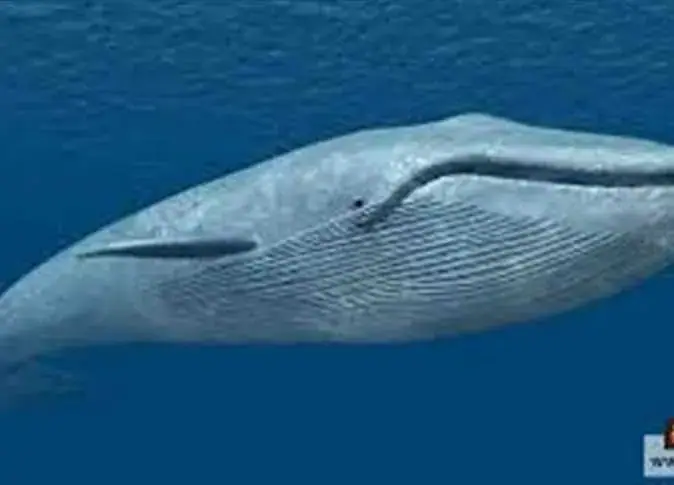
The recent circulation of videos showing a massive whale near Umm Qamar Island, north of Hurghada, has renewed interest in the types of whales that inhabit the Red Sea. The Red Sea Protected Areas Authority explained that this incident is significant because it aligns with existing scientific records documenting various whale species in the Egyptian Red Sea. Some species appear repeatedly in specific locations, while others have only been sighted on rare occasions.
Five major species of whales have been documented in the Egyptian waters of the Red Sea and the Gulf of Aqaba, including the humpback whale, Bryde's whale, Omura's whale, the pygmy blue whale, and the killer whale, also known as the orca. The humpback whale stands out as one of the species that has particularly captured the interest of both maritime professionals and researchers. Sightings were recorded in various locations during the years 2006, 2009, 2011, 2016, and 2021.
Humpback whales are known for behaviors such as breaching, leaping above the water's surface, and producing complex vocalizations. They also undertake long seasonal migrations between their feeding and breeding grounds. Their appearance in the Red Sea is a scientifically significant event, warranting the documentation of the time and location of the sighting, as well as prevailing environmental conditions.
There are both historical and relatively recent records of the Bryde's Whale in the Red Sea, dating back to 1950, 2008, 2009, and 2012. This species belongs to the group of baleen whales, which feed by filtering small marine organisms and fish from the water using baleen plates instead of teeth. The Omura's whale is another species whose sightings hold particular scientific significance, with one recorded near Safaga in 2009.
Records also document the appearance of a pygmy blue whale near Taba, in the Gulf of Aqaba, in 2018. This finding underscores the importance of the northern Red Sea and the Gulf of Aqaba as areas warranting further monitoring and study. Additionally, an orca that stranded near the Abu Galum area in South Sinai in 2017 highlights the importance of documenting marine mammal occurrences.
Historical records and references point to even earlier accounts of whales in the Red Sea, dating back to 1878 and 1893. A specialized scientific review confirms that 16 species of cetaceans have been recorded in the Red Sea, including three species of baleen whales and 13 species of dolphins and toothed whales.
The Director General of the Red Sea Protected Areas, Ahmed Ghallab, and the Director of the Northern Islands Protected Area, Abdallah Abed, emphasized the need for a comprehensive national system for monitoring marine mammals in the Red Sea. This would involve establishing a unified database to record whale and dolphin sightings, as well as the species identified, and archiving photographs, video footage, and relevant data for each encounter.
Key points
- Five major species of whales have been documented in the Egyptian waters of the Red Sea and the Gulf of Aqaba.
- The Red Sea serves as a habitat for some whale species, while others appear only intermittently as transient visitors from the Indian Ocean.
- A comprehensive national system for monitoring marine mammals in the Red Sea is necessary to track and study whale sightings.
Reporting sources
- Scientific records document 5 species of whales in Egypt’s Red Sea · Egypt Independent