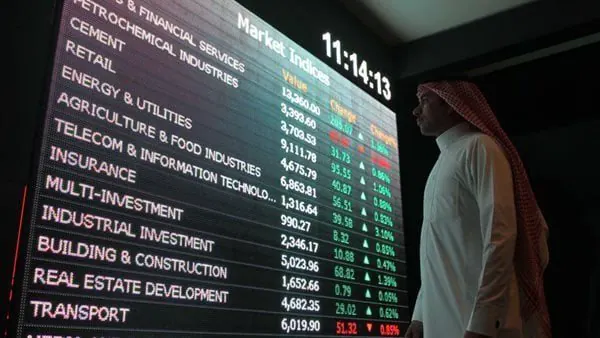
The Saudi stock market is on track to break its longest weekly losing streak since November 2025, with the main index, TASI, experiencing a volatile week of trading. Despite a 0.9% decline to 10,445 points on Thursday, the index's weekly losses have narrowed to around 0.5% compared to last week's close. Sectors such as energy, utilities, and basic materials have provided support, while banking stocks have faced pressure, according to Bloomberg.
The energy sector has been a key driver of gains, rising 2.3% compared to the end of last week, driven by the performance of Saudi Aramco. The utilities sector followed closely, with a 2.2% increase, while basic materials grew by 1.4%. In contrast, the banking sector declined by 1.2%. These movements have been influenced by fluctuations in global oil prices, with Brent crude rising 3.8% to over $104 per barrel, fueled by escalating military tensions in the region.
The increase in oil prices has been driven by concerns over supply disruptions, with the Strait of Hormuz seeing its lowest shipping traffic in over two months. Meanwhile, the yield on 10-year US Treasury bonds has climbed to 5.31%, nearing levels not seen since 2002. This has increased pressure on stock valuations and made fixed-income instruments more attractive. As a result, investors are closely monitoring the impact of these factors on the Saudi stock market.
Corporate earnings have also been a focus, with Extra and Tasheel for Financing announcing their third-quarter results. Extra's shares fell over 4% to 55.9 riyals, while Tasheel's shares dropped 5.6% to 25 riyals. Extra reported a 26.7% decline in net profit to 104.6 million riyals, below analysts' expectations of 127.8 million riyals. Despite a 5.5% increase in revenue, the company's profit decline was largely attributed to its consumer finance arm, Tasheel.
Tasheel's profit plummeted 82.4% to 14.1 million riyals, which was a significant drag on Extra's overall earnings. However, Extra's retail sector saw a 10.6% growth in profit, driven by increased revenue and improved margins. These results have contributed to the mixed performance of the Saudi stock market, as investors weigh the impact of geopolitical tensions and corporate earnings on their investments.
The Saudi stock market's performance has been influenced by the broader regional tensions, with investors seeking safe-haven assets amid the uncertainty. The market's ability to break its losing streak will depend on various factors, including the trajectory of oil prices, corporate earnings, and the overall geopolitical landscape. As the market navigates these challenges, investors are likely to remain cautious in their investment decisions.
Looking ahead, the Saudi stock market is expected to continue experiencing volatility, with investors closely monitoring developments in the region and corporate earnings reports. The performance of key sectors, such as energy and utilities, will be crucial in determining the market's direction. As the market seeks to break its longest weekly losing streak since November 2025, investors will be watching for signs of sustained recovery or further declines.
Key points
- Saudi stock market nears end of 5-week losing streak, longest since Nov 2025.
- Energy, utilities, and basic materials sectors provide support, while banking stocks face pressure.
- Corporate earnings, including Extra and Tasheel, impact market performance amid rising geopolitical tensions.