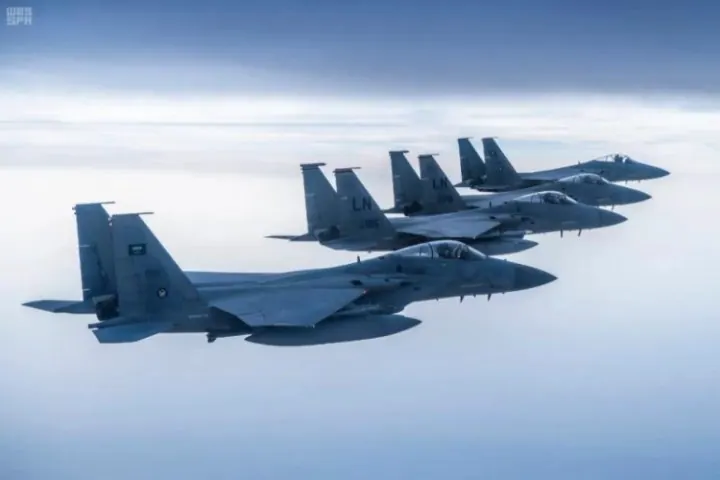
The Saudi-led coalition in Yemen announced on Monday its participation in an attack against the Houthi rebels through airstrikes. This comes as the Yemeni government launched an operation on Sunday to regain control of areas seized by the Houthis. The coalition's involvement was confirmed by its spokesperson, Turki Al-Malki, who stated that 100 fighter jets took part in the operation, dubbed "Fajr Yemen".
The airstrikes are part of a broader effort by the Yemeni government to retake control of territories captured by the Houthis. The rebels have been imposing a tight siege on the city of Taiz, located in southwestern Yemen. The city's residents have been facing severe shortages of food and medical supplies due to the blockade. The Yemeni government's operation aims to break the siege and restore access to the city.
The Houthi rebels have been in control of the western coast of Yemen, including the strategic Bab al-Mandab Strait, since September. The strait is a critical waterway for oil exports, including those from Saudi Arabia. The rebels' advances have raised concerns among regional and international powers, prompting the Saudi-led coalition to escalate its involvement in the conflict.
According to the spokesperson for the Yemeni government's forces, Maged Abdel Nazeel, over 1,000 strikes have been carried out against Houthi positions. The targets included artillery emplacements, missile launchers, and defensive fortifications. The operations were conducted using a range of assets, including fighter jets, drones, artillery, and snipers.
In a separate development, a pipeline used to transport Saudi oil exports was temporarily shut down after coming under attack on Sunday. The pipeline, which runs from eastern Saudi Arabia to the Red Sea, was hit in an area near the city of Riyadh. The attack caused significant damage, leading to a temporary halt in oil flows.
The conflict in Yemen has been ongoing since 2014, when the Houthi rebels seized control of large parts of the country, including the capital, Sana'a. The Saudi-led coalition intervened in the conflict in 2015, and a UN-brokered truce was agreed in 2022. However, fighting resumed in July, following a series of escalations between the Houthis and the Saudi-led coalition.
The renewed violence has raised concerns about the humanitarian situation in Yemen, where millions of civilians are in need of aid. The conflict has also had significant economic impacts, including the disruption of oil exports and the closure of critical infrastructure. The international community has called for a return to negotiations to end the conflict.
Key points
- The Saudi-led coalition has launched airstrikes against Houthi rebels in Yemen as part of a broader effort to support the Yemeni government.
- The conflict has had significant humanitarian and economic impacts, with millions of civilians in need of aid and critical infrastructure disrupted.
- The Houthi rebels have been in control of strategic areas, including the Bab al-Mandab Strait, which is a critical waterway for oil exports.