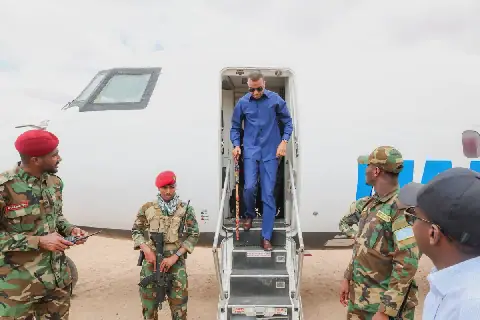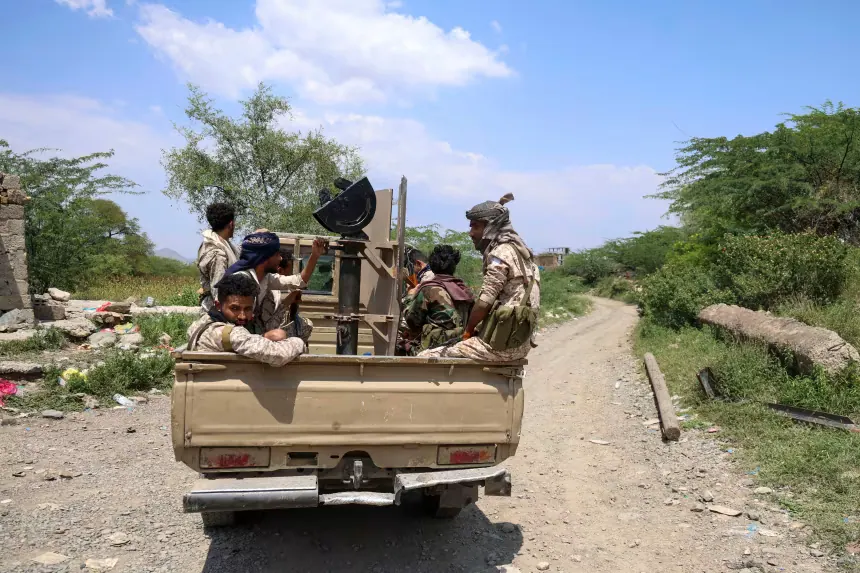
The Saudi-led "Coalition to Support Legitimacy in Yemen" has pledged full support for the Yemeni government's major military offensive against the Iran-backed Huthi movement. The offensive aims to reclaim territory held by the Huthis and restore state authority across the country. Yemen's internationally recognized government announced the start of the military operations on Sunday, following a series of Saudi airstrikes against Huthi positions and further Huthi gains in southern Yemen.
The renewed fighting has already forced tens of thousands of people from their homes, exacerbating an already bleak humanitarian crisis. According to the World Food Program, three out of every four families in parts of Yemen are going hungry due to the surge in fighting. The Huthis had carried out a lightning offensive down the Red Sea coast last month, seizing control of a key port and putting pressure on the safety of international shipping.
Rashad al-Alimi, head of Yemen's presidential council, said in a televised speech on Sunday that the military operations aimed to restore state authority and protect civilians, facilities, and international shipping lanes. He accused the Huthi militias of continued mobilization, escalation, and attacks, as well as threats against civilians and neighboring countries.
The Saudi-led coalition spokesperson, Turki al-Maliki, said they will continue providing "full operational support" to Yemeni government forces. He accused the Huthis of continuing attacks against Saudi Arabia and international shipping in the Red Sea and Bab al-Mandeb Strait, undermining regional and international security.
The Huthis claimed on Sunday that Saudi Arabia had carried out 106 air and missile strikes over the previous 24 hours, targeting the capital Sanaa and other areas of the country. In retaliation, the Huthis claimed they had struck vital Saudi energy facilities, causing large fires at the targeted sites. There has been no word from the Saudis on the claimed strikes.
The conflict in Yemen has resulted in significant humanitarian and economic costs. The war, which began in March 2015, had killed 377,000 people by the end of 2021, according to the United Nations. Over 150,000 of these deaths were the direct result of the armed conflict, while more have died as a result of hunger and disease due to the humanitarian crisis caused by the war.
Officials from Saudi Arabia will convene with Turkish and Pakistani officials in Riyadh on Monday to discuss regional developments. The meeting is part of the Strategic and Political Defense Committee, a NATO-style defense pact established in August, which aims to organize security and military cooperation in the region. The Saudi foreign ministry has said that it "does not represent an effort to establish a military axis or a sectarian bloc."
Key points
- The Saudi-led coalition has pledged full support for the Yemeni government's major military offensive against the Iran-backed Huthi movement.
- The renewed fighting has already forced tens of thousands of people from their homes, exacerbating an already bleak humanitarian crisis.
- The conflict in Yemen has resulted in significant humanitarian and economic costs, with 377,000 people killed by the end of 2021.