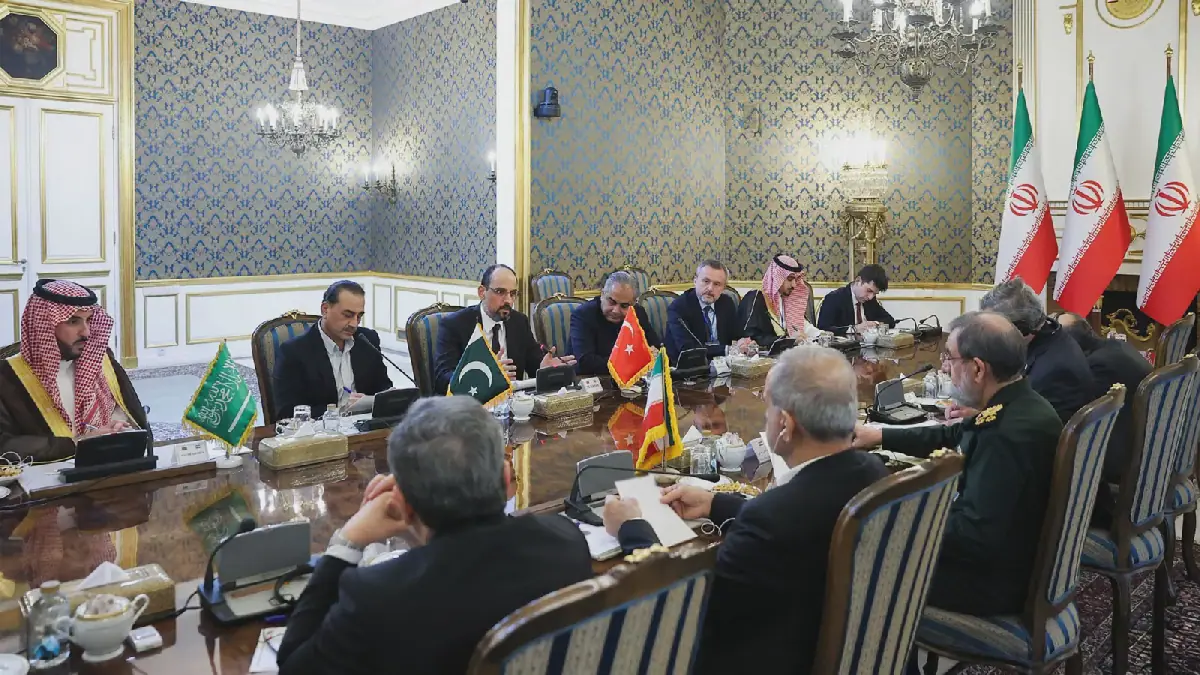
Senior officials from Saudi Arabia, Türkiye, and Pakistan, signatories to the Makkah Joint Defence Agreement, met Iranian leaders in Tehran on October 26 to discuss regional security, Houthi attacks on Saudi Arabia, and efforts to prevent further military escalation. The meeting brought together Saudi Defence Minister Prince Khalid bin Salman, Pakistan’s Chief of Army Staff Field Marshal Asim Munir, and Turkish National Intelligence Organisation Director Ibrahim Kalin with senior Iranian officials, including President Masoud Pezeshkian and Foreign Minister Abbas Araghchi.
The discussions included a possible regional non-aggression framework, the resumption of negotiations between the United States and Iran, efforts to halt Houthi attacks on Saudi Arabia, and security concerns surrounding the Strait of Hormuz. According to a joint statement reported by Iranian state media, the four countries agreed to continue dialogue to strengthen regional cooperation, peace, and security. The meeting provided an opportunity for the three Makkah pact members to communicate their security concerns directly to Tehran while exploring diplomatic options to contain the wider regional conflict.
Saudi Arabia described the visit as part of continuing efforts by the Makkah Joint Defence Agreement countries to reduce regional tensions, promote dialogue, and support diplomatic solutions. Saudi Deputy Minister for Public Diplomacy Ambassador Dr. Rayed Krimly said the visit was intended to support de-escalation and mediation efforts led by Qatar and Pakistan. The Saudi Ministry of Foreign Affairs stated that the visit aimed to encourage dialogue, open channels for negotiations, and prevent a return to military escalation.
Iranian state media presented the meeting as an opportunity to strengthen cooperation among regional countries and develop security arrangements led by countries in the region. President Pezeshkian expressed support for understandings aimed at strengthening unity among Muslim countries, saying regional countries could set an example of justice and development by pooling their resources and capabilities. Iran’s Supreme National Security Council Secretary Mohsen Rezaei described the discussions positively, saying they had created a new atmosphere for regional engagement.
Türkiye was represented by Ibrahim Kalin, director of the country’s National Intelligence Organisation. The meeting addressed regional security, Israel’s activities, and developments in Palestine and Lebanon. Ankara’s participation brought another regional power into direct security discussions with Iran while maintaining its defence partnership with Saudi Arabia and Pakistan under the Makkah Joint Defence Agreement.
Pakistan played a significant role in facilitating the engagement, following Field Marshal Munir’s visit to Tehran the previous week. A senior Pakistani security official said the discussions focused on the possibility of establishing a regional non-aggression framework. Another Pakistani official said Munir had presented a proposal intended to offer a compromise acceptable to both Washington and Tehran, although its details were not disclosed.
The Tehran meeting allowed Iran to present its position directly to Saudi Arabia, Türkiye, and Pakistan, whose Makkah pact establishes a defence partnership among the three countries. The talks also gave Türkiye an opportunity to participate in discussions on a possible regional security framework at a time when the conflict involving Iran, Israel, and the United States has heightened concerns across West Asia.
Key points
- Saudi Arabia, Türkiye, and Pakistan agreed to continue dialogue with Iran on regional security and possible US-Iran negotiations.
- The meeting discussed a possible regional non-aggression framework and efforts to halt Houthi attacks on Saudi Arabia.
- The Makkah Joint Defence Agreement countries aim to reduce regional tensions, promote dialogue, and support diplomatic solutions.