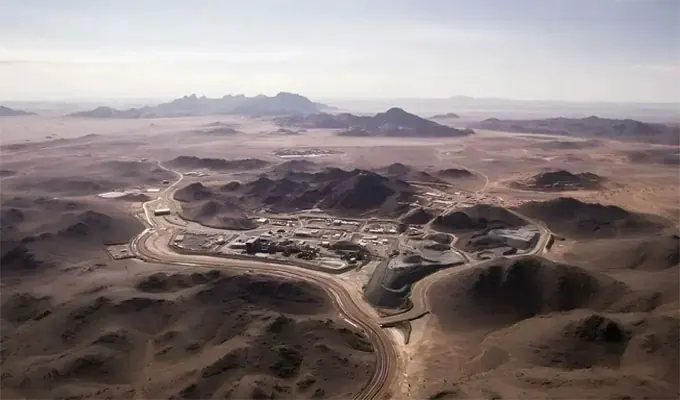
Saudi Arabia has announced the discovery of approximately 110 million tons of ore in Jabal Sayid, Medina region, containing high concentrations of rare earth elements and promising concentrations of uranium. The discovery was made by the Saudi Ministry of Energy, and its significance is being touted as a strategic find for the kingdom's economic diversification efforts. According to the announcement, the ore contains heavy rare earth elements, crucial for various technologies, including electronics, electric motors, and wind turbines.
The rare earth elements industry is highly concentrated, with China dominating the market. In 2024, China accounted for around 60% of rare earth extraction for magnets, 91% of refining, and 94% of permanent magnet production, according to the International Energy Agency. While the discovery of Jabal Sayid is significant, it remains to be seen whether it can challenge China's dominance. The extraction, refining, and processing of rare earth elements require substantial industrial capabilities, which Saudi Arabia will need to develop.
The Jabal Sayid discovery combines a substantial volume of ore with rare earth elements and promising uranium concentrations. This find aligns with Saudi Arabia's Vision 2030 plan, which aims to diversify the economy beyond hydrocarbons and develop the mining sector. The uranium discovery could also support Saudi Arabia's nuclear energy ambitions, although it is too early to determine the full extent of the reserves.
According to sources, the estimated 110 million tons of ore is a significant find, although some reports cite a slightly higher figure of 114 million tons. However, these numbers refer to the estimated ore volume, not the actual amount of rare earth elements or uranium. The true significance of the discovery will depend on the grade, recoverable volumes, extraction costs, and industrial processing capabilities.
The Saudi government is optimistic about the potential of Jabal Sayid, with Minister of Energy Prince Abdulaziz bin Salman announcing the discovery at the IAEA General Conference in Vienna. The find has the potential to become a strategic asset for Saudi Arabia, contributing to the country's economic diversification efforts.
Rare earth elements are essential for various technologies, including renewable energy systems and electric vehicles. Securing a stable supply of these elements is crucial for countries looking to transition to cleaner energy sources. The Jabal Sayid discovery could play a significant role in meeting this demand, although further development and investment are needed to realize its full potential.
As Saudi Arabia seeks to develop its mining sector and reduce its reliance on hydrocarbons, the Jabal Sayid discovery presents an opportunity for growth and diversification. The kingdom will need to invest in the necessary infrastructure and technology to extract and process the ore, creating new opportunities for economic development and job creation.
Key points
- The discovery of 110 million tons of rare earth and uranium ore in Jabal Sayid has significant implications for Saudi Arabia's economic diversification efforts.
- The rare earth elements industry is highly concentrated, with China currently dominating the market.
- The Jabal Sayid discovery aligns with Saudi Arabia's Vision 2030 plan, which aims to develop the mining sector and reduce reliance on hydrocarbons.