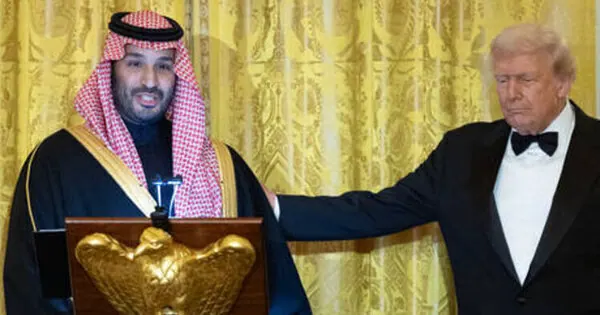
A classified US intelligence assessment has raised concerns about Saudi Arabia's nuclear ambitions, fueling debate over President Donald Trump's civilian nuclear deal with Riyadh. The assessment was included in documents provided to lawmakers reviewing the landmark agreement, which lays the groundwork for American companies to participate in civilian nuclear projects in Saudi Arabia. The deal, signed in July, aims to strengthen nonproliferation standards while preventing Riyadh from turning to Russia or China for nuclear cooperation.
The agreement creates a potential pathway for Saudi Arabia to enrich uranium domestically, with initial enrichment capped below 5% but potentially rising to 20% with US and Saudi approval. While this level remains below weapons grade, it reduces the work required to reach weapons-grade concentrations. The pact does not require Saudi Arabia to adopt the International Atomic Energy Agency's Additional Protocol, which provides inspectors with broader access to detect undeclared nuclear activity. Instead, the US and Saudi Arabia have negotiated a separate bilateral safeguards arrangement.
Democratic senators, including Ed Markey and Jeff Merkley, have expressed concerns that the deal could give Riyadh the means to enrich uranium and possibly develop nuclear weapons. Merkley noted that Saudi Arabia's insistence on retaining the option of domestic enrichment raised questions about its ambitions. The State Department has rejected suggestions that the US is facilitating a military program, stating that it "does not and will not support a Saudi nuclear weapon program."
Saudi Energy Minister Abdulaziz bin Salman has insisted that Riyadh's program will be "peaceful" and developed with "the highest levels of responsibility and transparency." However, concerns have been raised about Saudi Crown Prince Mohammed bin Salman's 2018 statement that Riyadh would seek an atomic bomb if Iran acquired one. The intelligence assessment has added to longstanding concerns about the Saudi agreement, which lawmakers have contrasted with the stricter 2015 Iran nuclear deal.
The Saudi agreement was formally submitted to Congress on August 24 and is undergoing a 90-day review. Lawmakers can seek to block it, although overriding a presidential veto would require a two-thirds majority in both chambers. The review process has sparked debate about the implications of the deal, with some lawmakers questioning whether it does enough to prevent Saudi Arabia from developing nuclear weapons.
The US intelligence assessment has also raised questions about the Trump administration's approach to nuclear cooperation with Saudi Arabia. The administration has argued that the arrangement will strengthen nonproliferation standards, but some lawmakers have expressed skepticism about this claim. The controversy highlights the challenges of balancing nuclear cooperation with nonproliferation concerns.
As the review process continues, lawmakers will need to weigh the potential benefits of the agreement against the risks of nuclear proliferation. The outcome will have significant implications for US-Saudi relations and the global nuclear landscape. Key stakeholders will be watching closely as the debate unfolds.
Key points
- Saudi Arabia has not ruled out developing nuclear weapons, according to a US intelligence assessment.
- The US and Saudi Arabia have negotiated a separate bilateral safeguards arrangement.
- Lawmakers are reviewing the agreement and can seek to block it, although overriding a presidential veto would require a two-thirds majority in both chambers.