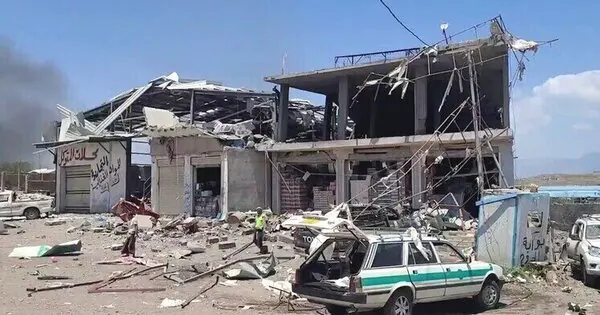
A significant escalation in Yemen has led Saudi Arabia to re-engage in military action against the Iran-backed Houthis, ending years of relative calm. The renewed fighting comes as tensions escalate across the Middle East. Much of the conflict has occurred along Yemen's Red Sea coast and around the strategically important Bab el-Mandeb Strait. The Houthis have made significant territorial gains, prompting a Saudi-backed counteroffensive.
The Houthis, formally known as Ansar Allah, are a Zaydi Shia armed and political movement that emerged in northern Yemen in the 1990s. Their stronghold is the mountainous province of Saada, along the border with Saudi Arabia. The movement opposes Yemen's central government and Saudi and US influence. The Houthis now control much of northern and western Yemen, including areas where most of the country's population lives. They are backed by Iran and describe themselves as part of the Tehran-aligned "Axis of Resistance."
The conflict in Yemen began in 2014 when the Houthis seized Sanaa, forcing the internationally recognized Yemeni government from the capital. Saudi Arabia intervened in 2015 at the head of a military coalition seeking to restore the government and counter Iran's growing influence. Years of fighting failed to dislodge the Houthis, but a UN-brokered truce in 2022 reduced hostilities. The truce formally expired after six months, but hostilities remained limited until recently.
The recent escalation began in July when Yemeni government forces struck the runway at Sanaa airport to prevent an Iranian plane carrying a Houthi delegation from landing. The Houthis blamed Saudi Arabia for the airport strike and retaliated against the kingdom. The conflict further escalated in September when the Houthis made their largest territorial gains in years, taking Mocha and key positions along the Red Sea coast and around Bab el-Mandeb.
Saudi Arabia's involvement in the conflict is driven by its direct security concerns, as the Houthis have repeatedly demonstrated their ability to strike deep inside the kingdom. After years of costly fighting, Saudi Arabia had sought to reduce its direct involvement and pursued talks with the Houthis following the 2022 truce. However, the Houthis' recent advances have brought Riyadh back into major military action. The Saudi-led coalition has launched Operation Dawn of Yemen, providing air cover for government forces.
The US-Israeli war on Iran has contributed to the escalation in Yemen. Iranian advisers helped the Houthis plan and carry out their September offensive along Yemen's Red Sea coast. The US has not resumed direct strikes against the Houthis but is providing Riyadh with intelligence, target identification, and operational planning. Western countries, including the UK and France, are also providing military support to Riyadh.
The renewed fighting in Yemen is adding pressure to already strained global energy markets. Oil prices have climbed, with Brent crude trading above $101 a barrel and US benchmark West Texas Intermediate around $90, amid concerns over global supplies. The Bab el-Mandeb strait, a critical waterway connecting the Red Sea with the Gulf of Aden, has become especially important since the US-Israeli war on Iran disrupted shipping through Hormuz.
Key points
- The conflict in Yemen has escalated, with Saudi Arabia re-engaging in military action against the Iran-backed Houthis.
- The Houthis have made significant territorial gains, prompting a Saudi-backed counteroffensive.
- The renewed fighting is adding pressure to global energy markets, with oil prices climbing amid concerns over supplies.