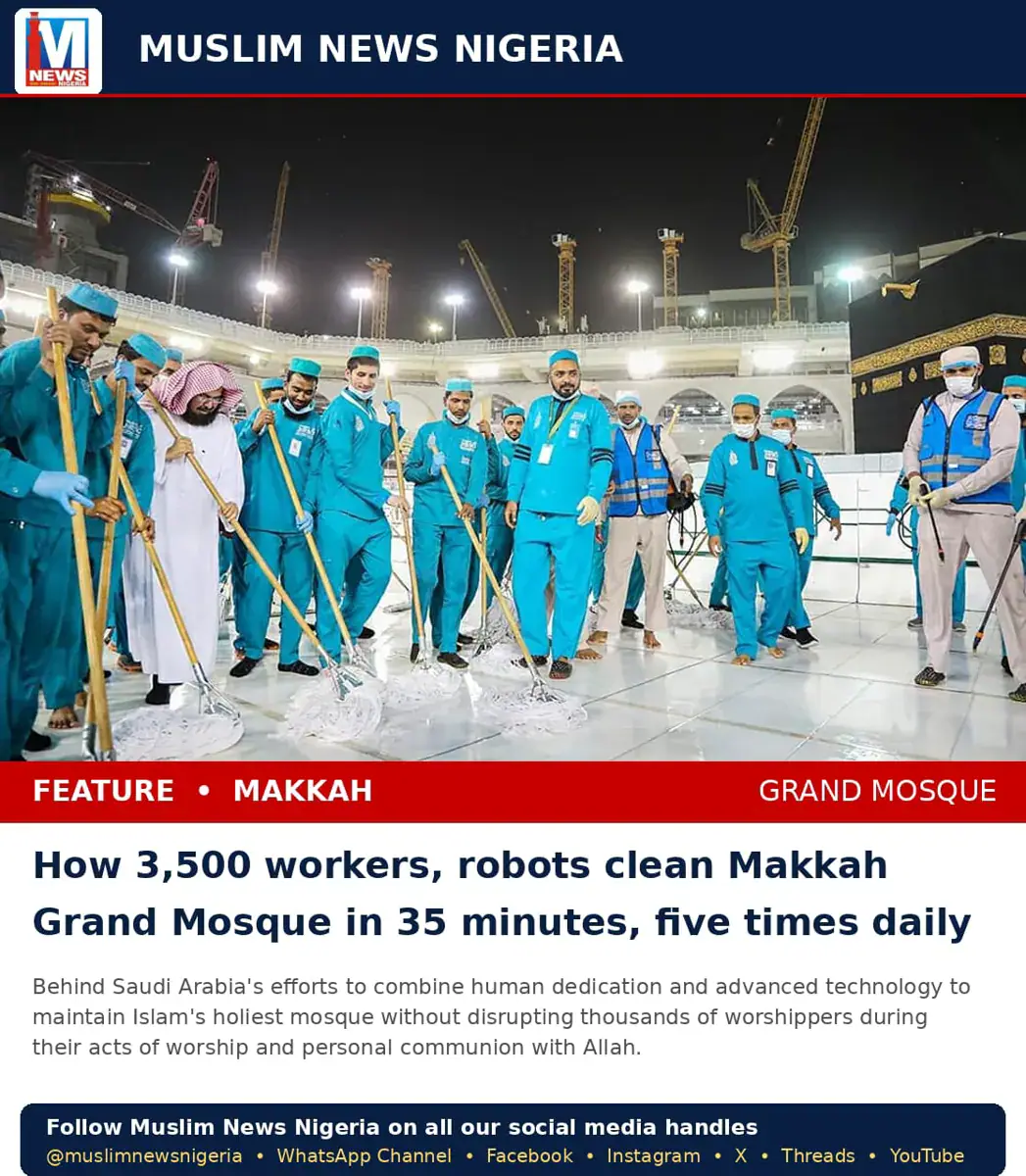
The Grand Mosque in Makkah, Saudi Arabia, undergoes a massive cleaning operation five times daily, involving 3,500 workers and 679 machines. The coordinated effort takes approximately 35 minutes to clean the mosque, with workers washing the Mataf, the area surrounding the Holy Kaaba, in about 20 minutes. This operation ensures the mosque remains clean and welcoming for millions of worshippers, pilgrims, and visitors. The mosque covers over 1.8 million square meters and can accommodate more than 2.5 million worshippers.
The cleaning operation is supported by modern technology, including 12 specialized washing machines and 679 cleaning machines. Some automated robots can wash over 1,000 square meters of flooring per hour, equipped with cameras and sensors to detect people and obstacles. These robots operate quietly to avoid disturbing worshippers and can work for up to eight hours without direct human intervention. The introduction of these technologies is part of Saudi Arabia's wider adoption of digital solutions to improve services at the Two Holy Mosques.
The use of robotics in the cleaning operation began during the COVID-19 pandemic. In June 2021, 10 smart robots were introduced to support sterilization operations at the Grand Mosque, capable of working for between five and eight hours without human intervention. A smart disinfection robot was inaugurated on October 27, 2021, which could cover over 2,000 square meters per hour. The robot used cameras and sensors to identify people and obstacles while washing and disinfecting floors.
Beyond the machines and robots, specialized human teams maintain different parts of the Grand Mosque. Dedicated workers handle the rooftop, escalators, minarets, and staircases, while another team polishes brass fittings, including lanterns, railings, and decorative features on the mosque's columns. This arrangement ensures that different sections receive attention from personnel trained for specific cleaning and maintenance responsibilities.
Waste management is also a significant part of the operation, with around 70 tonnes of refuse collected and evacuated from the Grand Mosque every day. The figure rises to approximately 100 tonnes during periods of heavy activity. To support the exercise, over 3,000 waste containers are maintained inside and outside the mosque. The General Authority for the Care of the Grand Mosque and the Prophet's Mosque confirmed that environmentally friendly cleaning materials are used.
The extensive cleaning and maintenance arrangements are part of Saudi Arabia's broader responsibility for the management, expansion, and development of the Two Holy Mosques. Successive Saudi administrations have invested in expanding the Grand Mosque, upgrading its facilities, improving crowd management, and introducing modern technologies to accommodate the growing number of Muslims visiting Makkah for Hajj, Umrah, and other acts of worship.
The commitment to maintaining the cleanliness of the Grand Mosque carries profound religious significance, as stated in the Quran, where Allah recounts His instruction to Prophet Ibrahim (AS) to purify the Sacred House. For the 3,500 men and women working behind the scenes, supported by modern technology and a coordinated management system, the task goes beyond ordinary cleaning, helping millions of Muslims fulfill their religious obligations in the holiest mosque in Islam.
Key points
- The Grand Mosque cleaning operation involves 3,500 workers and 679 machines, removing 70 tonnes of waste daily.
- The operation is supported by modern technology, including automated robots that can work for up to eight hours without human intervention.
- The cleaning effort is part of Saudi Arabia's broader responsibility for the management, expansion, and development of the Two Holy Mosques.
Reporting sources
- How 3,500 workers, robots clean Makkah Grand Mosque in 35 minutes, five times daily · Muslim News Nigeria