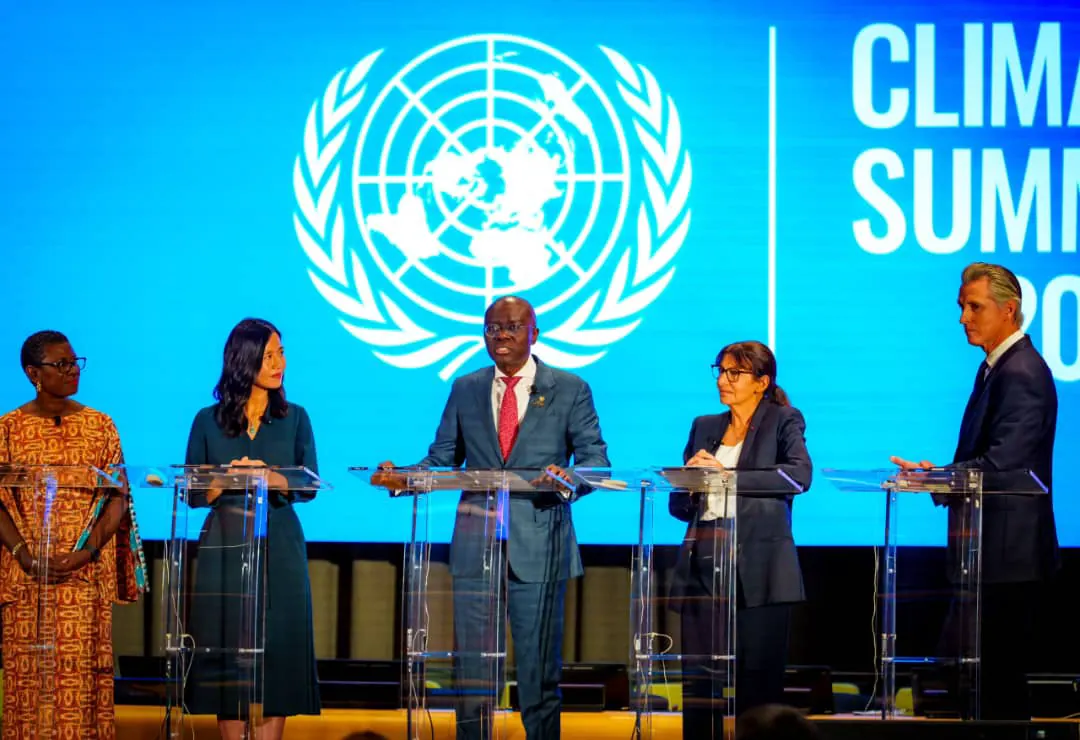
Lagos State Governor, Babajide Sanwo-Olu, has called for stronger global partnerships and improved access to affordable, long-term finance for subnational governments to accelerate climate action and ensure a just transition. Sanwo-Olu made the call while addressing Heads of State and Government at the United Nations High-level Meeting on Climate Action and the Just Transition, held during the 81st session of the United Nations General Assembly (UNGA) in New York. The meeting focused on accelerating the global energy transition, strengthening climate adaptation, and mobilizing climate finance.
Sanwo-Olu spoke at the meeting as a representative of the Under2 Coalition, a global network of state and regional governments committed to ambitious climate action. Lagos is a member of the coalition. The governor said climate action in Lagos was being pursued as part of the state’s broader development strategy, particularly in the areas of urban resilience, transportation, waste management, and economic development. He emphasized that climate action is central to how Lagos builds its future.
Sanwo-Olu highlighted Lagos’ efforts to reduce the environmental impact of its rapid urbanization, including the transition towards cleaner transportation and initiatives aimed at converting the more than 5,000 tonnes of solid waste generated daily into economic value through recycling, circular-economy practices, and clean energy. He stressed that these efforts are not abstract climate policies but decisions that can create jobs, improve services, strengthen resilience, and make everyday life better for millions of people.
The governor also emphasized the role of states and regions in implementing climate policies, saying subnational governments are responsible for a significant share of climate action on the ground. Sanwo-Olu noted that Lagos’ participation in the Under2 Coalition had provided an avenue for the state to exchange experiences with other jurisdictions while contributing its own perspective as one of Africa’s largest urban economies.
Sanwo-Olu stressed that climate plans would require stronger financial support to translate them into infrastructure and measurable projects. He said states and regions need access to affordable, long-term finance that can help turn strong plans into infrastructure on the ground. The governor added that development finance institutions, investors, and the private sector need to see the opportunity in climate investment in emerging markets.
The Lagos State government is intensifying efforts to move from climate policy formulation to investment and project implementation through the state’s Office of Climate Change and Circular Economy (OCCE). The office is working to translate the state’s climate priorities under its State-Determined Contributions (SDCs) Framework into investable projects and practical implementation pathways. The major challenge now is to bridge the gap between policy commitments and available capital.
As part of its strategy, Lagos is developing a Climate Finance and Investment Platform designed to connect the state’s climate priorities with capital, technology, financial institutions, and implementation partners. Sanwo-Olu’s UNGA engagement is part of Lagos’ wider international climate program ahead of COP31 in Antalya, Türkiye, where the state plans to present its climate investment proposition and engage investors, development finance institutions, financial institutions, project developers, and technology partners.
Key points
- Sanwo-Olu calls for stronger global partnerships and improved access to affordable finance for subnational governments to accelerate climate action.