Samuel Ladoke Akintola was born on July 6, 1910, in Ogbomosho, present-day Oyo State, to Akintola Akinbola and Akanke. His early education began at C.M.S. Minna, where his family relocated in 1914. He later attended Baptist Day School in Ogbomosho and Baptist College, completing his elementary education in 1930. Akintola's foundational understanding of Western education, gaining traction across southern Nigeria, was instilled during these formative years.
Akintola's career began as a teacher at Baptist Academy in Lagos from 1930 to 1942, exposing him to the growing community of educated individuals in the colonial capital. He then briefly joined the Nigerian Railway service in 1942 before moving into journalism with Ernest Ikoli's Nigerian Daily Service Newspaper, becoming its editor in 1943. Akintola also founded Iroyin Yoruba, a Yoruba-language newspaper, showcasing his entrepreneurial spirit and cementing his reputation as a formidable communicator.
In 1946, Akintola received a British scholarship to study in the United Kingdom, initially enrolling for Public Administration at Oxford before shifting his focus to law. He completed his legal studies by 1950, qualifying as a barrister and being called to the English Bar. His years abroad immersed him in a fervent intellectual atmosphere, bringing him into contact with other West African students and political activists debating colonial rule and constitutional reform.
Upon his return to Nigeria in 1949, Akintola established himself in legal practice and formed a partnership with fellow legal practitioners. His legal expertise and growing public profile brought him closer to Yoruba political and cultural organizations, particularly the Action Group (AG), spearheaded by Chief Obafemi Awolowo. Akintola swiftly became one of the AG's most indispensable figures, serving as its legal adviser and later as deputy leader in 1953.
Akintola's influence extended beyond regional party politics into the federal government, serving as parliamentary leader of the Action Group in the House of Representatives and Leader of Opposition. He held significant ministerial portfolios, including Minister of Labour, Minister of Health, and Minister of Communications and Aviation. During his tenure as Minister of Health, Akintola allocated £10 million for the completion of the University College Hospital in Ibadan.
As Minister of Communications and Aviation, Akintola played a pivotal role in establishing Nigerian Airways in 1957, breaking the British Airways monopoly. He traveled to Holland to secure new aircraft, and Nigerian Airways officially launched on October 1, 1958, with a capital of £6 million sterling. These initiatives demonstrated his vision for a self-sufficient and modern Nigeria.
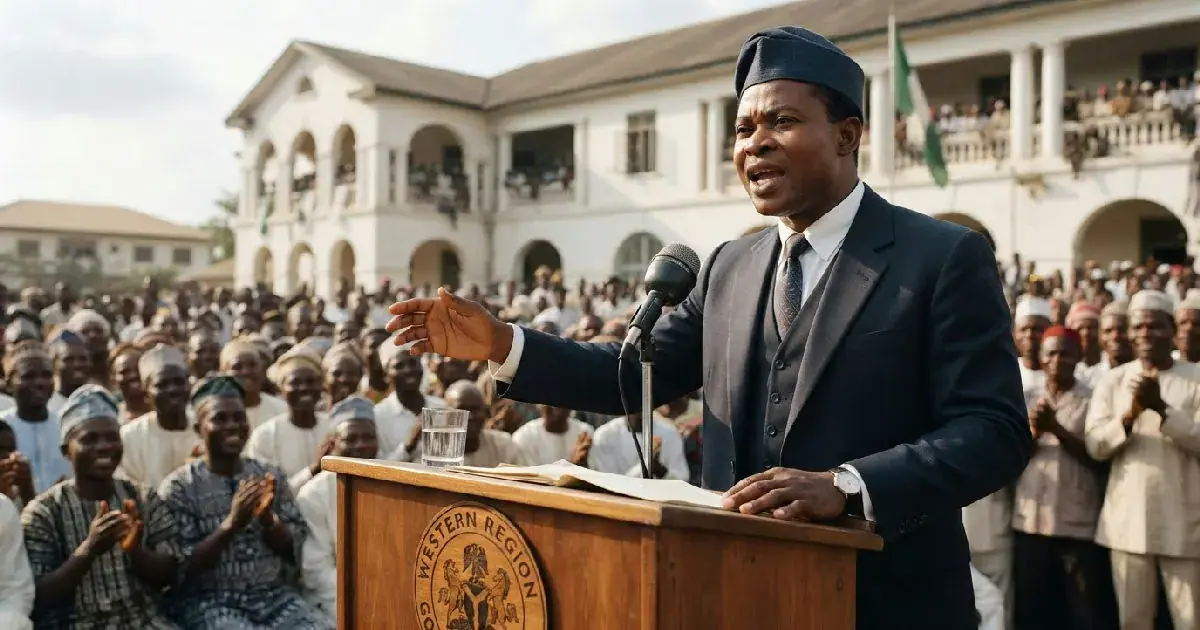
Samuel Ladoke Akintola's political zenith came in late 1959 when he became the Premier of the Western Region, effectively swapping roles with Chief Obafemi Awolowo. His ascension marked a significant milestone in his career, shaped by his diverse background, education, and experience in journalism, law, and politics. Akintola's leadership had a lasting impact on Nigeria's pre-independence and First Republic politics.
Key points
- Akintola's career trajectory exemplified the ambition and evolving opportunities available to educated Nigerians in the mid-20th century.
Reporting sources
- Samuel Ladoke Akintola rose from newsroom to premier · Nigerian Compass