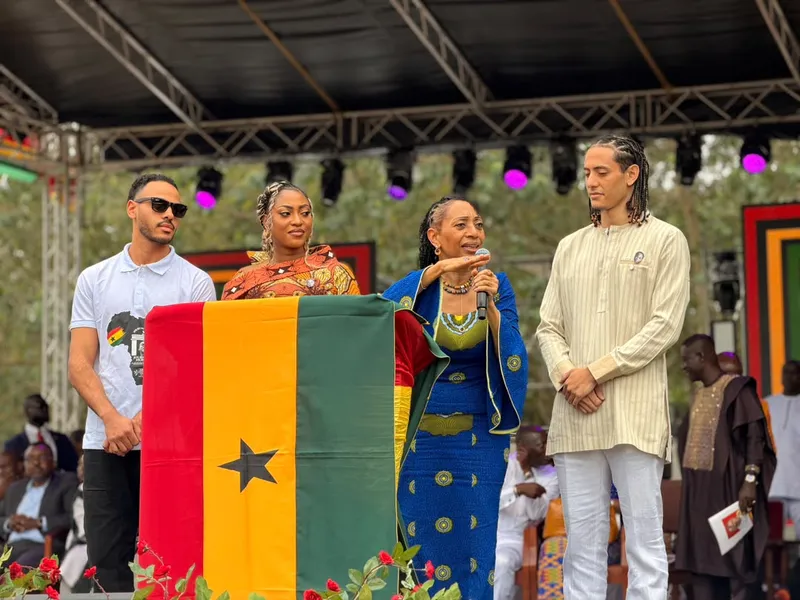
Samia Yaba Nkrumah, daughter of Ghana's first President, Osagyefo Dr Kwame Nkrumah, has rejected claims that Ghanaians were happy after his overthrow in 1966. Speaking at the 2026 NkrumahFest at Nkroful in the Ellembelle District of the Western Region, Samia described such accounts as part of what she considers negative narratives about Nkrumah's legacy. She recalled the destruction of Nkrumah's statue following the overthrow of his government.
The destruction of the monument and celebrations surrounding the overthrow should not be interpreted as representing the feelings of all Ghanaians, Samia said. "That negative propaganda that Osagyefo when he left, Ghanaians were happy is not true," she said. According to her, the celebrations and destruction of Nkrumah's statue were not universal and should not be taken as a representation of the entire country.
Samia expressed appreciation to individuals and organisations working to document what she considers a more accurate account of Nkrumah's life and political legacy. She also pointed to the unveiling of a new statue of Nkrumah at a roundabout in Sunyani as an indication, in her view, of renewed interest in the former President's ideas. The unveiling was particularly significant to her because of the contrast between the new monument and the earlier destruction of Nkrumah's statue.
Samia said the unveiling of the new statue was a symbol of Ghana's rising interest in Nkrumah's ideas. "When we unveiled the statue at the roundabout, I realised that yes, we are going to rise. Nzimaland will rise, Africa will rise, Ghana will rise, and Africans everywhere are going to rise," she said. She stressed that the importance of such monuments was not in the statues themselves but in the ideas they are intended to represent.
Samia pushed back against descriptions of Nkrumah as an isolationist or a rigid leader whose ideas were disconnected from the wider world. She argued that his commitment to Ghanaian nationalism and Pan-Africanism did not prevent him from developing relationships with people from different countries and continents. "They say he was an isolationist. They say he was dogmatic, rigid in his ideas. Let me tell you, this is not true," she said.
According to Samia, Nkrumah's international relationships demonstrated that his Ghanaian nationalism existed alongside a broader Pan-African outlook. She said the Nkrumah family's renewed involvement in NkrumahFest was partly aimed at ensuring that younger generations have the opportunity to examine his ideas and legacy beyond what she described as negative historical narratives.
The Nkrumah family wants to help reconnect young Ghanaians and Africans with Nkrumah's philosophy and his vision for the continent. Samia said it was essential for younger generations to understand Nkrumah's ideas and legacy accurately. The family is working to preserve Nkrumah's legacy and ensure that his ideas continue to inspire future generations.
Key points
- Samia Nkrumah rejects the narrative that Ghanaians universally welcomed her father's overthrow in 1966.
- A new statue of Nkrumah was unveiled in Sunyani, indicating renewed interest in his ideas.
- Samia Nkrumah argues that her father's commitment to Ghanaian nationalism and Pan-Africanism did not make him an isolationist.