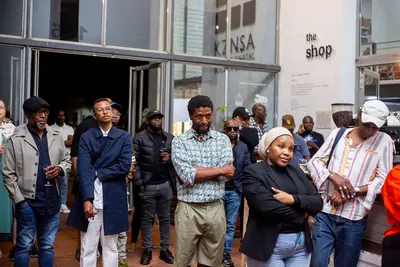
Renowned photographer Sabelo Mlangeni's latest exhibition, 'Honeymoon. The happily ever after?', is now on display at KZNSA in Durban. The exhibition is a culmination of Mlangeni's five-year project, which began as a joke when he told people he was on his honeymoon after his wedding documentary series, Isivumelwano. This project has evolved into a comprehensive portrayal of Durban, showcasing its beauty, contradictions, and the lives of its people.
Mlangeni's work is characterized by its ability to evolve and adapt, moving from one subject to another, and changing his formal language. His previous exhibition, Ngiyobona Phambili, featured landscapes made during his six years in Europe, where he explored the experience of being a South African photographer abroad. In 'Honeymoon', Mlangeni returns to his hometown of Durban, capturing the city's vibrant life, including its informal settlements, damaged buildings, and infrastructural neglect.
The exhibition features photographs of black people enjoying leisure activities, such as swimming, kissing, and playing, alongside images of the city's scars, including the 2021 unrest and 2022 floods. Mlangeni's work challenges the historical representation of black people in visual culture, where they were often depicted as laborers, servants, or objects of poverty. By photographing black people occupying leisure spaces, Mlangeni is creating a new narrative that celebrates black joy and desire.
Mlangeni's project is part of a larger photographic lineage that seeks to challenge colonial and apartheid visual cultures. His work is reminiscent of Luvuyo Equiano Nyawose's eBhish', which confronted the historical absence of black leisure from the archive by constructing a contemporary archive of black oceanic presence. Mlangeni's approach, however, is distinct, as he moves through Durban's broader landscape, capturing the interdependence of the city's people, architecture, and environment.
The exhibition is notable for its installation, which refuses the traditional grid in favor of a more bodily and organic arrangement. Photographs are hung high and low, some framed, others unframed, and some overlapping while others are given considerable distance. This arrangement creates a sense of intimacy and immediacy, drawing the viewer into the world of the photographs. Mlangeni's use of space and composition adds to the overall sense of affection and reverence for his subjects.
Mlangeni's personal experience with the city is evident in his work, as he has faced challenges, including having his car stolen and being beaten and robbed of his camera while photographing the ocean. Despite these experiences, Mlangeni remains committed to capturing the essence of Durban and its people. The exhibition is a testament to his dedication to his craft and his love for the city and its inhabitants.
The 'Honeymoon' exhibition is a significant development in Mlangeni's practice, showcasing his ability to capture the complexities and beauty of Durban. The exhibition will be on display at KZNSA, allowing viewers to experience the work in the same streets where it was created. Mlangeni's work is a celebration of black life and leisure, and a powerful challenge to historical narratives that have marginalized and erased black people from visual culture.
Key points
- Sabelo Mlangeni's 'Honeymoon' exhibition showcases black leisure and life in Durban, highlighting the city's beauty and contradictions.
- The exhibition challenges historical representations of black people in visual culture, celebrating black joy and desire.
- Mlangeni's use of space and composition creates a sense of intimacy and immediacy, drawing the viewer into the world of the photographs.