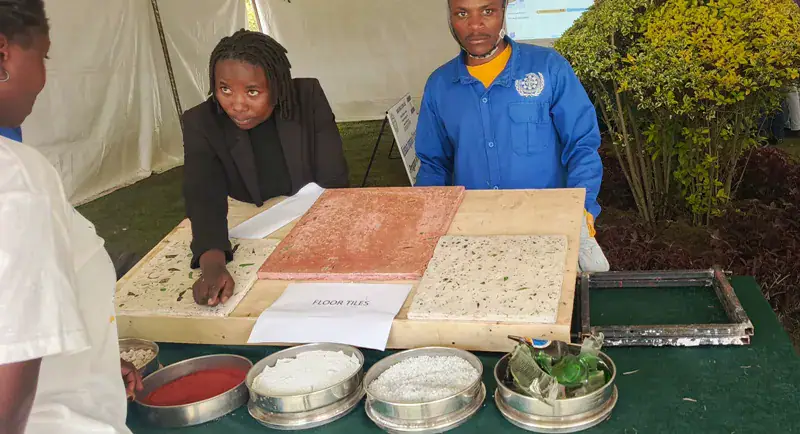
Students at the MIPC Muhabura school in Rwanda's Musanze district have developed an innovative way to reuse waste glass from bottles, transforming it into valuable construction materials such as paving stones. This initiative, born out of a research project, aims to address environmental concerns and create job opportunities. The students collect waste glass, crush it, mix it with other materials like sand and cement, and mold it into desired shapes. This process not only reduces waste but also produces eco-friendly building materials.
The idea behind this project was to find solutions to environmental problems, particularly the issue of waste glass littering the streets of Musanze. The students, led by Janvier Niyogisubizo, a civil engineering student, discovered that waste glass can be repurposed into useful products. They mix the crushed glass with sand from Giciye, white cement, small stones, and other materials to create durable and aesthetically pleasing construction materials. These materials can be used for paving roads, building paths, and other infrastructure projects.
According to Niyogisubizo, this initiative has not only provided them with a source of income but also taught them the importance of recycling and sustainable practices. The students claim they can produce up to 600 paving stones per day using specialized machinery, depending on the materials and work progress. Their goal is to expand this project, potentially setting up a large-scale factory to produce these eco-friendly materials.
The project has garnered support from the local community, with residents like Niwemugeni praising the initiative for its environmental and economic benefits. Niwemugeni purchased some of the paving stones and was impressed by their quality, affordability, and potential to enhance his surroundings. He believes this project aligns with Rwanda's "Made in Rwanda" campaign, promoting local production, job creation, and environmental conservation.
Manzi Innocent, the director of MIPC Muhabura, emphasizes the importance of research and innovation in schools, enabling students to apply theoretical knowledge to real-world problems. The school administration supported the students' research, which ultimately led to the development of this innovative project. Innocent encourages students to continue exploring new ideas and solutions to address societal challenges.
Research studies have shown that waste glass can be used to produce concrete and paving stones, replacing some of the sand and aggregate materials traditionally used. A study published in Scientific Reports in 2024 found that incorporating waste glass into paver block production can improve their strength and durability. Another study published in Environmental Science and Pollution Research in 2021 highlighted the potential of using waste materials in construction, reducing the environmental impact of raw material extraction.
While experts agree that using recycled glass in construction has potential, they stress the need for further testing to ensure the materials meet safety and quality standards. Proper processing and handling of waste glass are crucial to prevent any adverse effects on human health and the environment. If implemented on a larger scale, this initiative could contribute significantly to Rwanda's circular economy, reducing waste and promoting sustainable development.