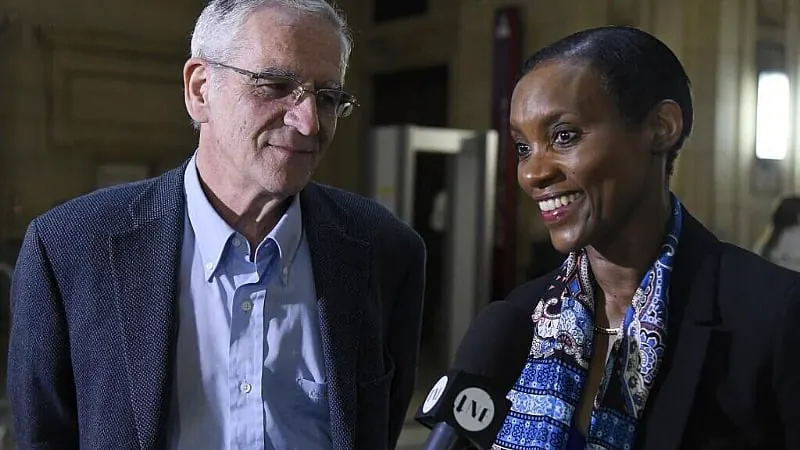
Dafroza Gauthier, a renowned Rwandan genocide hunter, passed away on Saturday in Reims, France, where she had lived with her family since the 1980s. She is survived by her husband, Alain, and their three children. Gauthier dedicated her life to seeking justice for victims of the 1994 Rwandan genocide, often risking her own safety to bring perpetrators to account. Her tireless efforts have been compared to those of Serge and Beate Klarsfeld, the famous Nazi hunters.
Gauthier's journey into genocide hunting began with her own experiences of ethnic violence in Rwanda. Born on August 4, 1954, in Butare, southern Rwanda, into a Tutsi farming family, she witnessed her family's house being burned and property looted. Her mother sent her and her sister to Burundi for safety in 1973. Gauthier later moved to Belgium, where she studied chemistry, and eventually met her husband, Alain, a French teacher who was working in Rwanda.
In February 1994, Gauthier returned to Rwanda to visit her family, only to find herself in the midst of escalating violence. She saw militia on the streets of Kigali and heard Hutu extremists broadcasting hate speech against Tutsis. Her mother urged her to leave, but Gauthier's own family was affected by the violence. On April 8, 1994, her mother was shot dead in a Kigali church. This traumatic event fueled Gauthier's determination to seek justice for the victims of the genocide.
In 2001, Gauthier and her husband attended the trial in Belgium of four people accused of taking part in the genocide, which resulted in convictions. Later that year, they founded the Collective of Civil Plaintiffs for Rwanda (CPCR), an association that filed civil suits against dozens of genocide suspects in France. The CPCR's efforts led to several high-profile cases, including the conviction of Dominique Ntawukuriryayo, who played a role in the killing of up to 25,000 Tutsi refugees.
The Gauthiers' investigations uncovered several suspects living in France, including former chief of intelligence Pascal Simbikangwa, who was tried in Paris for genocide and crimes against humanity in 2014. He was found guilty and sentenced to 25 years in prison. Seven suspects have received final convictions and prison sentences ranging from 14 years to life, thanks to the CPCR's efforts. Gauthier's work was driven by a desire for justice, rather than revenge.
Christophe Renzaho, president of the Rwandan Community in France expat group, paid tribute to Gauthier, describing her as a "remarkable person" who "knew no bounds when it came to bringing those who committed genocide against the Tutsis to justice." Gauthier often spoke about the importance of seeking justice, saying that "speaking helps us heal." Her legacy will continue to inspire efforts to bring perpetrators of genocide to account.
Gauthier's passing has been met with tributes from around the world, with many acknowledging her tireless dedication to seeking justice for the victims of the Rwandan genocide. Her work has left a lasting impact on the pursuit of justice for genocide crimes, and her memory will continue to inspire those working towards accountability and healing for the victims and their families.
Key points
- Dafroza Gauthier died on October 2, 2026, in Reims, France.
- Gauthier and her husband founded the Collective of Civil Plaintiffs for Rwanda (CPCR) in 2001.
- Seven suspects have received final convictions and prison sentences for their roles in the genocide.