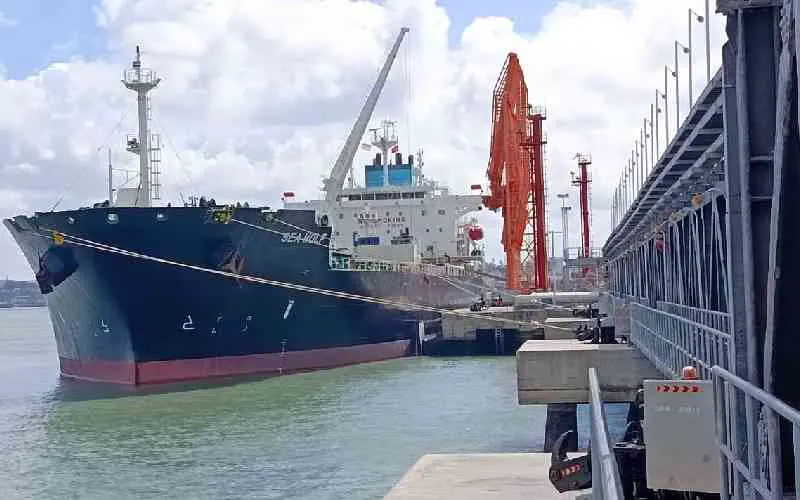
Rwanda has begun importing petroleum products through Kenya's Port of Mombasa, marking a significant shift in the country's logistics strategy. A 40,000 metric ton cargo of petroleum oil arrived at Kipevu Oil Terminal 2, received by Energy Cabinet Secretary Opiyo Wandayi and Rwandan Minister of Infrastructure Hon. Armand Zingiro. This development is the result of a Government-to-Government fuel importation programme, following a Memorandum of Understanding and tripartite agreement signed on June 29, 2026.
The agreement allows Rwanda to utilize Kenya Pipeline Company (KPC)'s network and storage tanks for its petroleum imports. Wandayi emphasized that this milestone strengthens Kenya and Rwanda's energy cooperation and reinforces the Port of Mombasa's role as a regional petroleum supply gateway. He confirmed Kenya's commitment to working with Rwanda to ensure reliable, efficient, and secure energy supplies.
The partnership is expected to significantly increase petroleum products transiting through Kenya, growing from 50,000 cubic meters per year to over 500,000 cubic meters. KPC extended its storage window for products owned by RNEC to 90 days, up from the standard 35 days permitted for other oil firms. This move aims to retain and attract Rwanda's business, reclaiming a 90 percent market share lost to Tanzania.
Minister Zingiro highlighted that the new route through the Northern Corridor will provide Rwanda with a reliable and cost-effective way to import refined petroleum products. The framework developed by the two governments capitalizes on Kenya's port infrastructure, pipeline network, and logistics ecosystem. This agreement supports Rwanda's strategy to diversify import routes, strengthen fuel security, and make petroleum products available for economic growth.
As a landlocked country, Rwanda has previously imported most of its petroleum cargo through the port of Dar es Salaam, with Kenya only getting 10 percent of the market share. The new agreement marks a significant change, with Rwanda now using Kenya's Port of Mombasa as its primary import route. This shift is expected to boost security and continuity of petroleum supply, free up logistical bottlenecks, and make import flows more predictable.
Wandayi and Zingiro expressed optimism about the partnership, citing its potential to enhance energy security through regional cooperation. The agreement is seen as a practical result of nearly three years of close collaboration between the two governments. Kenya and Rwanda aim to work together to ensure a stable and secure energy supply for years to come.
The arrival of the MT Sea Wolf at Kipevu Oil Terminal 2 marks the activation of the Kenya route for Rwanda's petroleum imports. The two countries' governments have demonstrated a shared vision to strengthen energy security through regional cooperation, and this new route is expected to have a positive impact on Rwanda's economy and industrial development.
Key points
- Rwanda will use Kenya's Port of Mombasa for petroleum imports following a 40,000 metric ton cargo arrival.
- The agreement is expected to increase petroleum products transiting through Kenya by over 10 times.
- The partnership aims to enhance energy security and provide a reliable and cost-effective way for Rwanda to import refined petroleum products.