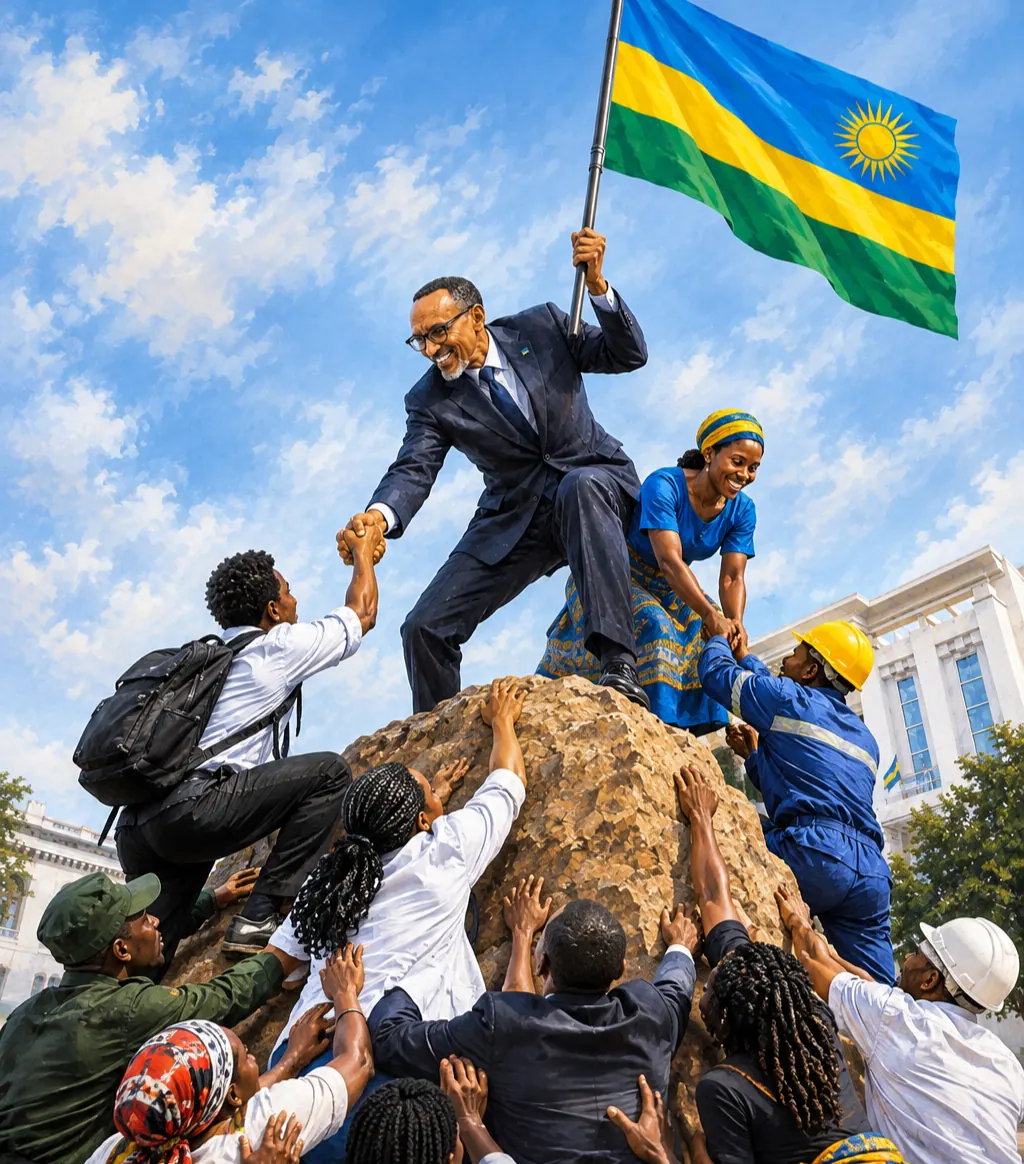
Rwanda has taken a significant step towards reducing its dependency on foreign aid with the adoption of the Rwanda Development Cooperation Policy (RDCP) 2026 to 2050. The new policy, approved by the Cabinet on September 18, 2026, marks a shift in the country's approach to international relations, focusing on trade, investment, technology, and mutually beneficial cooperation. This move is a culmination of over two decades of efforts by President Paul Kagame's administration to make Rwanda self-reliant.
When President Kagame assumed office in 2000, Rwanda was still rebuilding its institutions, economy, and social fabric after the 1994 Genocide against the Tutsi. International assistance played a crucial role in the country's recovery, but Kagame had already expressed his desire to wean Rwanda off aid in a 2009 interview with CNN. The country's progress in reducing aid dependency is evident in its 2026/27 national budget, where domestic resources account for approximately 68 percent of the total financing envelope, while foreign grants represent about 7 percent.
Rwanda's shift towards self-reliance is a result of a deliberate strategy that has involved investing heavily in diplomacy and international connectivity. The country has sought to position itself as a partner pursuing opportunities across Africa and around the world, rather than simply as a recipient of international support. Diplomatic relationships have become channels for investment, tourism, trade, technology transfer, and strategic cooperation.
Stability and security have been critical components of Rwanda's development strategy. The government has prioritized security, institutional capacity, and national cohesion to create an environment conducive to infrastructure development, healthcare, education, and private investment. This approach has paid off, with the Rwanda Development Board reporting $2.62 billion in registered investment across 799 projects in 2025, and export receipts reaching $3.6 billion.
Tourism has also become a significant economic and diplomatic asset for Rwanda, generating approximately $685 million in 2025. The Meetings, Incentives, Conferences, and Exhibitions (MICE) sector has contributed nearly $95 million, but its importance extends beyond conference revenues, as it brings investors, policymakers, entrepreneurs, and business leaders to Kigali, creating relationships and networks that can lead to partnerships.
Rwanda's journey towards self-reliance can be understood in three phases: a humanitarian and reconstruction era from 1994 to 2006, a period of recovery and transformation from 2006 to 2026, and an era of sovereign partnerships from 2026 onward. While aid remains part of Rwanda's financing structure, its relative importance has declined significantly, and the country is increasingly focused on exchanging value with the world.
The achievement of reduced aid dependency is a testament to Rwanda's strategic objective of becoming a self-reliant nation. The country's progress is evident in its ability to generate resources through economic activity, and its focus on trade, investment, innovation, and strategic cooperation is expected to continue in the coming years.
Key points
- Rwanda adopts new development policy to reduce aid dependency and focus on trade, investment, and strategic partnerships.
- The country's 2026/27 national budget shows domestic resources accounting for approximately 68 percent of the total financing envelope.
- Rwanda's investment and export performance has improved significantly, with $2.62 billion in registered investment and $3.6 billion in export receipts in 2025.