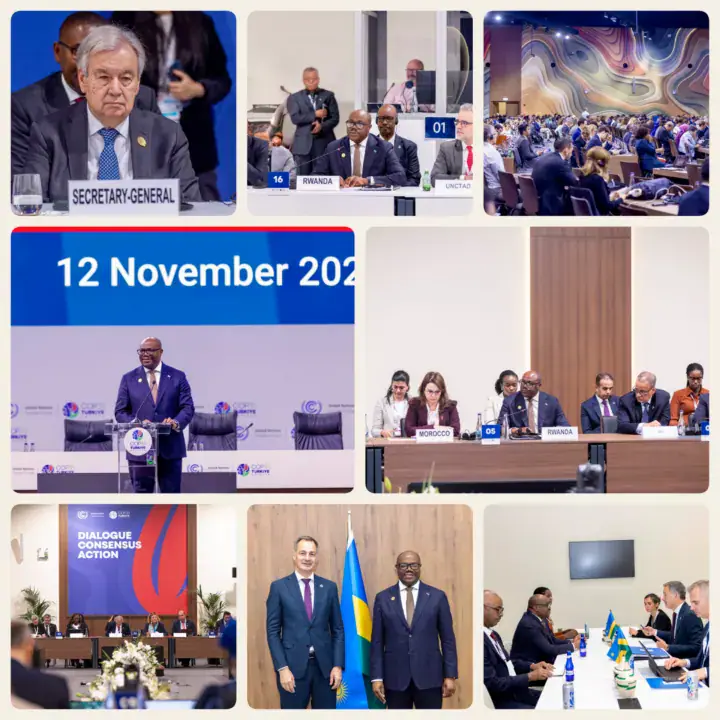
The Government of Rwanda is seeking greater international investment in electricity infrastructure, urban resilience, green industrialisation, and climate-smart agriculture. Prime Minister Justin Nsengiyumva outlined the country's priorities during several high-level engagements at the COP31 climate conference. Rwanda called for stronger partnerships with multilateral development banks, development finance institutions, and other international partners to turn its climate commitments into projects that can attract financing and deliver measurable results.
On November 11, Nsengiyumva participated in the High-Level Dialogue on Seizing the Green Industrial Opportunity – Investment, Jobs and Growth for Every Economy. The discussions examined how countries can use the transition to cleaner economies to attract investment, create jobs, and expand industrial capacity. Rwanda highlighted opportunities in renewable energy, clean cooking, electric mobility, sustainable agriculture, and the circular economy.
The Prime Minister also attended the High-Level Event on the Global Grids Accelerator, titled Powering the Future – Grids for Energy Security and Prosperity. The event focused on the role of electricity transmission networks in improving energy security, expanding access, and supporting economic growth. Rwanda presented an estimated US$3.05 billion in overall investment needs for its electricity ambitions, including US$1.3 billion for grid infrastructure.
The country called for greater access to project financing from multilateral development banks and development finance institutions to help deliver the required infrastructure. Nsengiyumva also participated in a high-level roundtable marking the second decade of the Paris Agreement, which focused on accelerating implementation and improving access to climate finance. Rwanda outlined its national frameworks, including Vision 2050, the Green Growth and Climate Resilience Strategy, and the Rwanda Green Fund.
Urban resilience was another major focus of the Prime Minister's engagements. At the High-Level Dialogue on Urban Resilience, Adaptation and Climate Action, discussions centred on the growing costs of climate-related risks in cities and the financing required to protect urban populations and infrastructure. Rwanda presented investments of about US$195 million in Kigali, including the restoration and protection of five wetlands covering approximately 500 hectares.
These interventions are intended to reduce flooding risks for more than 220,000 residents. The country also highlighted the need to strengthen resilience in secondary and satellite cities as urbanisation expands beyond Kigali. Its updated climate commitments under the third Nationally Determined Contribution (NDC 3.0) provide a framework for addressing these challenges. Rwanda also pointed to international cooperation, including Türkiye's Sustainable Urban Resilience for the Future Fund (SURFF).
Across the different engagements, Rwanda's message was that climate commitments must be backed by financing and partnerships capable of delivering projects on the ground. The country is seeking to move beyond policy commitments towards investments in power infrastructure, resilient cities, green industries, and agriculture that can support its long-term development ambitions.
Key points
- Rwanda seeks $3.05 billion in investment for electricity infrastructure, including $1.3 billion for grid infrastructure.
- The country aims to reduce flooding risks for over 220,000 Kigali residents through investments in urban resilience projects.
- Rwanda calls for stronger partnerships with multilateral development banks and development finance institutions to support climate commitments.