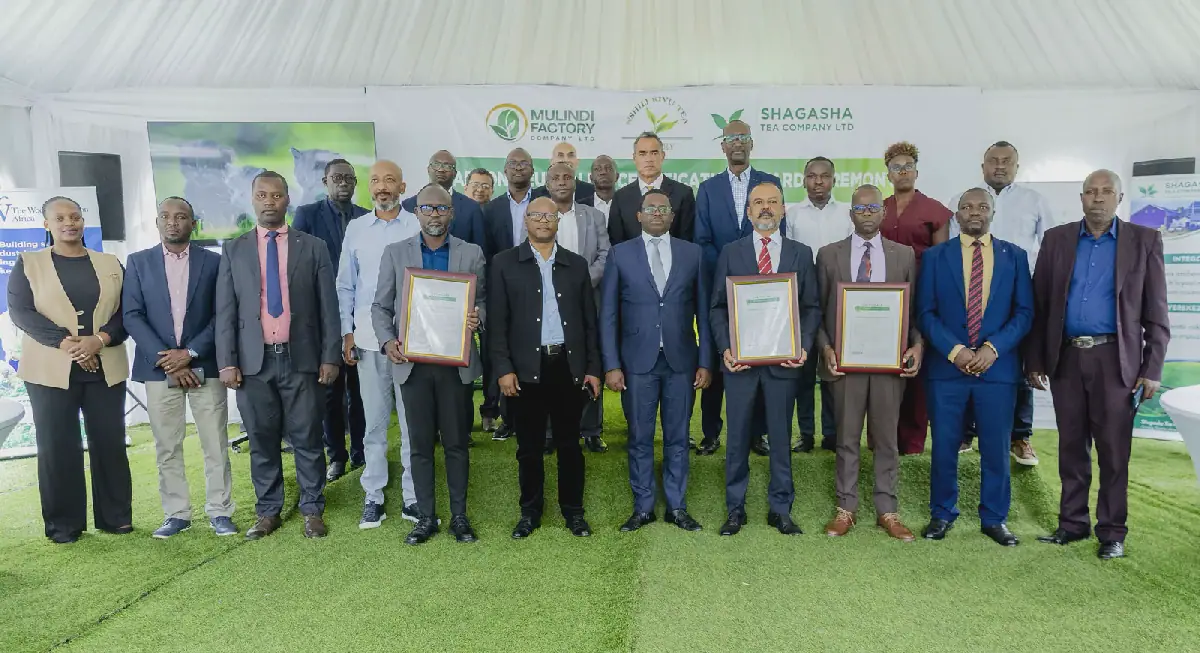
Three tea factories in Rwanda, namely Mulindi Tea Factory, Nshili Kivu Tea Factory, and Shagasha Tea Factory, have received certificates confirming that their tea processing operations are environmentally friendly. The certificates were awarded on November 24, 2026, after a joint inspection by various stakeholders, including the government and The Wood Foundation Africa. This development is expected to increase the value of Rwandan tea in the international market.
The Minister of Agriculture and Animal Resources, Olivier Kamana, stated that Rwandan tea is already popular in the international market, but the environmentally friendly certification will further enhance its value. He mentioned that Rwanda exports tea worth over $114 million annually, with over 100,000 farmers involved in tea production. Kamana emphasized that the certification is a significant step towards sustainable tea production and will help Rwanda mitigate the effects of climate change.
The inspection conducted in 2025 revealed that the three tea factories have the potential to absorb more carbon dioxide from the atmosphere than they emit during tea processing. This makes them eligible for the certificates. The National Agricultural Export Board (NAEB) Chief Executive Officer, Claude Bizimana, noted that this development is a significant milestone for Rwanda's tea industry, as it demonstrates the country's commitment to environmentally friendly practices.
The inspection was conducted by international experts specializing in carbon footprint assessment and verification. The assessment was based on international standards, including ISO 14064-3 for verification of greenhouse gas emissions and ISO 14068 for carbon neutrality. The certificates were awarded after a thorough examination of the factories' operations, including energy consumption, transportation, and waste management.
Avinash Kumar, CEO and co-founder of Earthood, an Indian-based company that conducted the inspection, explained that the assessment involved calculating the amount of greenhouse gas emissions from each factory and verifying the data through on-site visits. He stated that the factories not only offset their emissions but also absorb more carbon dioxide from the atmosphere than they emit.
The tea factories' environmentally friendly practices involve implementing measures to reduce greenhouse gas emissions and promoting sustainable agriculture practices. The factories have taken steps to reduce their carbon footprint, including using renewable energy sources and implementing reforestation programs. These efforts are expected to contribute to Rwanda's overall goal of reducing greenhouse gas emissions and mitigating the effects of climate change.
The certification of the three tea factories is a significant step towards promoting sustainable tea production in Rwanda. With 19 tea factories operating in the country, the government aims to encourage more factories to adopt environmentally friendly practices. The certification is expected to increase the competitiveness of Rwandan tea in the international market and provide a premium price for farmers.
Key points
- The certification of the three tea factories demonstrates Rwanda's commitment to environmentally friendly practices and sustainable tea production.