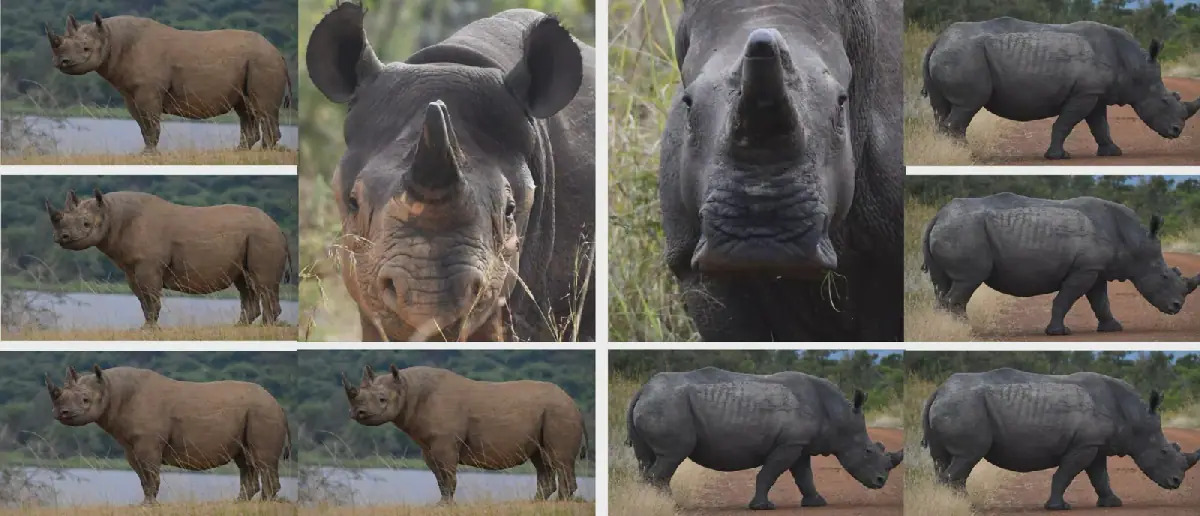
Akagera National Park in Rwanda is home to both black and white rhinos, two species that often attract tourists. However, many people are unaware of the distinct differences between them. The park's management has pointed out that while the names and colors of the rhinos may differ, their appearance can be distinguished by their body shape, which can be influenced by their habitat and environment.
According to the park's management, several key differences can help identify whether a rhino is black or white. These include the shape of their mouth, size, head, and behavior. White rhinos have a wide, flat mouth that allows them to eat large amounts of grass, while black rhinos have a longer, more pointed upper lip that helps them grab leaves and branches from bushes.
In terms of size, white rhinos are significantly larger than black rhinos. They are the second-largest land animal in Africa, after elephants, and can weigh up to 2,000 kilograms. Black rhinos, on the other hand, typically weigh between 800 and 1,400 kilograms. Despite their smaller size, black rhinos are known for their agility and speed.
The shape of a rhino's head and face can also be a distinguishing feature. White rhinos have a longer head that slopes downwards, which is adapted for grazing on grass. Black rhinos, by contrast, have a shorter head and a more upright face, which allows them to be more alert and aware of their surroundings.
The behavior of black and white rhinos also differs. White rhinos tend to be more social and often live in small groups in open grasslands, where they can graze peacefully. Black rhinos, on the other hand, prefer to live alone or in small groups in areas with more vegetation and are known to be more territorial and defensive.
Another notable difference between the two species is the way they interact with their young. When a white rhino is with its calf, the calf often walks in front of its mother. In contrast, a black rhino calf tends to follow its mother. Additionally, white rhinos are more likely to form groups, while black rhinos tend to live alone, especially when they are not breeding or with their calves.
Akagera National Park has encouraged visitors to observe and learn about these amazing creatures, taking photos to share with others and promote awareness and conservation. The park's management has emphasized that understanding and appreciating the differences between black and white rhinos can help promote conservation efforts and support the protection of these incredible animals.
Key points
- The main differences between black and white rhinos include their mouth shape, size, head shape, and behavior.
- White rhinos are larger and more social, while black rhinos are smaller and more territorial.
- Understanding these differences can help promote conservation efforts and support the protection of these incredible animals.