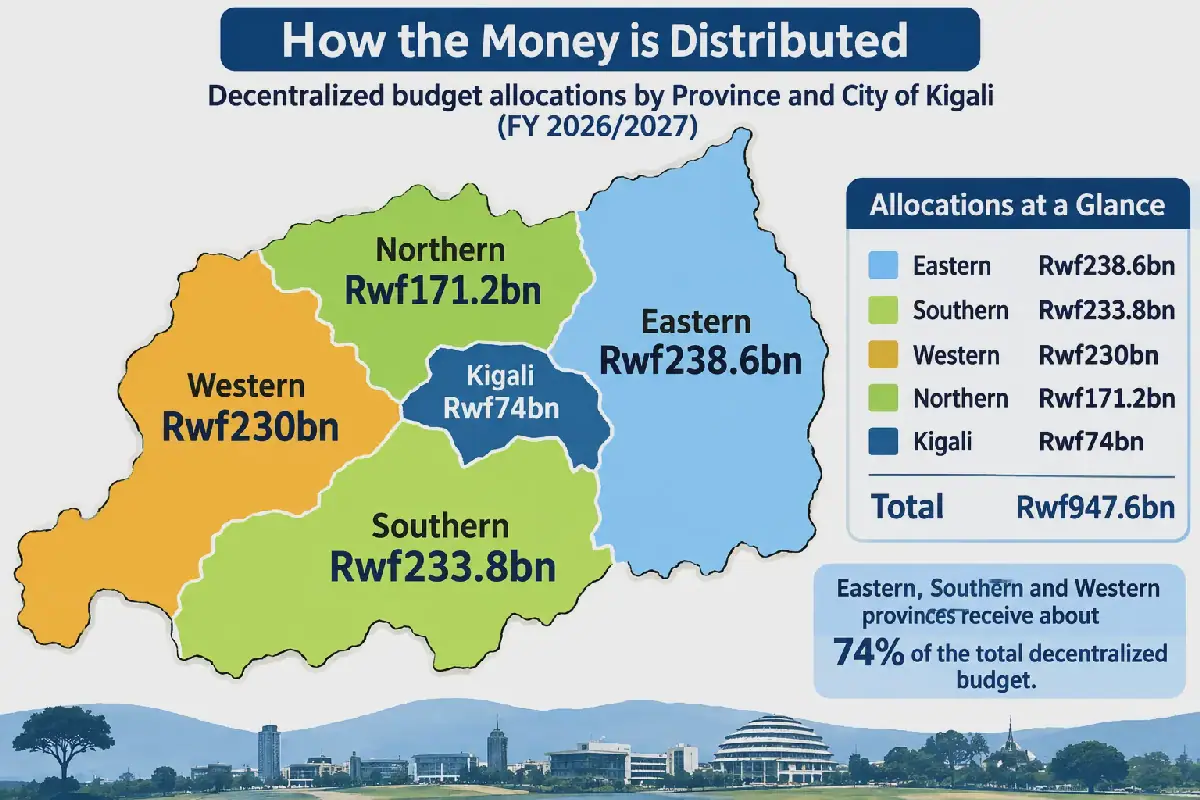
Rwanda's Ministry of Finance and Economic Planning has released its 2026/2027 Budget Factsheet, revealing significant disparities in government funding allocated to the country's five administrative areas. Eastern Province has been allocated Rwf238.6 billion, followed by Southern Province with Rwf233.8 billion, and Western Province with Rwf230 billion. In contrast, Northern Province will receive Rwf171.2 billion, while the City of Kigali has been allocated Rwf74 billion.
The total national budget for the 2026/2027 financial year stands at Rwf7,796.3 billion, up from Rwf6,952.1 billion in the revised 2025/2026 budget. The decentralized allocations to provinces and districts account for approximately 12.2% of the national budget. The remaining resources cover national programs, salaries, infrastructure investments, and other government expenditures. The allocated Rwf947.6 billion to provinces and Kigali does not include revenues generated locally and approved through their respective councils.
The allocation differences may be attributed to population distribution, with Eastern Province having approximately 3.56 million residents, making it Rwanda's most populous province. Southern Province has about three million people, while Western Province has approximately 2.9 million. Northern Province has around 2.04 million residents, compared to approximately 1.75 million in Kigali. The larger populations in Eastern, Southern, and Western provinces result in greater demand for public services.
The number of districts in each province could also influence the distribution of government funding. Southern Province has eight districts, Eastern and Western each have seven, Northern has five, and Kigali has three. More districts generally mean more local administrative structures and potentially greater demand for government transfers. Additionally, rural communities and agricultural support play a significant role in decentralized funding.
When examining allocations per person, Northern Province receives approximately Rwf84,000 per resident, compared to Rwf67,000 in Eastern Province. Western and Southern provinces receive approximately Rwf79,000 and Rwf78,000 per resident, respectively. Kigali receives approximately Rwf42,000 per resident. This suggests that Northern Province's lower overall allocation is partly explained by its smaller population.
The rural population is another factor to consider, with more than three-quarters of residents in each of the four provinces living in rural areas. The proportion is particularly high in Southern Province, where about 85% of the population lives in rural communities. In contrast, only about 13% of Kigali's population lives in rural areas. This difference affects decentralized funding, which includes programs such as school feeding and agricultural support.
The budget disparities raise questions about how Rwanda distributes public resources among its administrative areas. The government may need to reassess its allocation methods to ensure equitable distribution of funds. Key factors to consider include population distribution, district numbers, and rural community needs.
Key points
- Eastern, Southern, and Western provinces receive significantly more government funding than Kigali and Northern Province.
- Northern Province receives more funding per person than other provinces.
- The budget disparities may be attributed to population distribution, district numbers, and rural community needs.