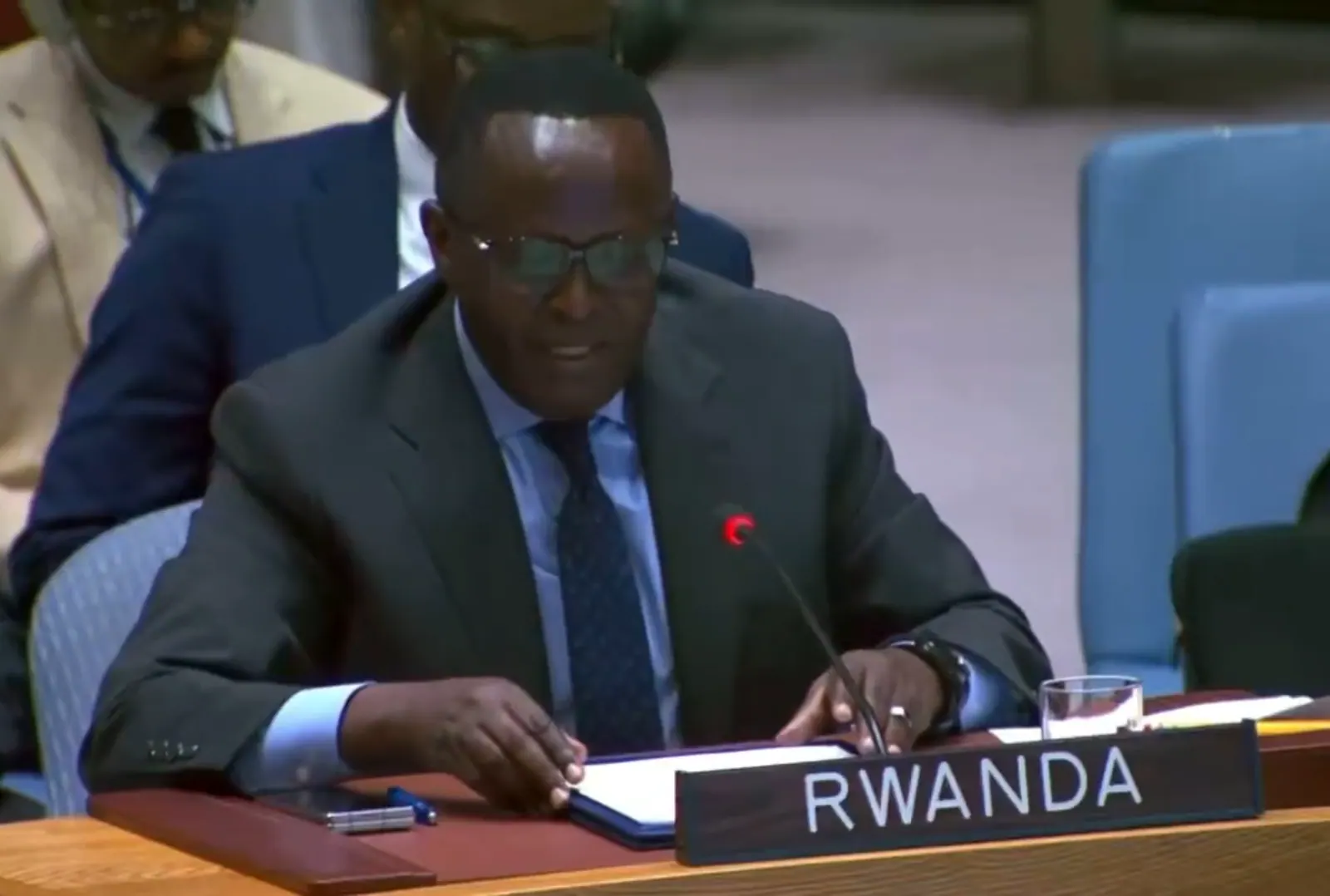
Rwanda's Permanent Representative to the United Nations, Martin Ngoga, addressed the UN Security Council on Tuesday, stating that Rwanda and the Democratic Republic of Congo have identified and mapped the locations of the FDLR armed group. This mapping was carried out through the Joint Security Coordination Mechanism, one of the bodies created under the Washington peace process. Ngoga accused Kinshasa of delaying action to neutralize the group, despite having knowledge of its locations.
Ngoga cited several incidents of cooperation between the Congolese army, FARDC, and the FDLR in 2026, including the transportation of ammunition and supplies to FDLR and other armed groups. He alleged that on February 10 and 11, a FARDC helicopter and military trucks transported 13 tons of small-calibre ammunition to Pinga and Kibua. Additionally, on March 8, a FARDC helicopter transported 12 tons of ammunition and food rations to Ntoto.
Ngoga criticized an arrangement being pursued between the Congolese government and the FDLR, describing it as a delaying tactic that does not amount to the neutralization agreed under the Washington process. He stated that the Congolese government has concluded protocols with FDLR leaders and affiliated groups on several occasions, including a recent agreement signed on August 29, 2026. Ngoga emphasized that the FDLR's neutralization must be effective, complete, and verifiable.
The FDLR's presence is described by Ngoga as a direct and existential security threat to Rwanda, citing the group's genocidal ideology and support from the Congolese government. He highlighted the geographical proximity of eastern Congo to Rwanda, noting that Goma and Bukavu are only three to five hours by road from Kigali. Ngoga compared Rwanda's size to Maryland in the United States, emphasizing that an armed group operating next to Rwanda's border cannot be treated as a remote security concern.
Rwanda has proposed a tripartite verification mechanism involving Rwanda, the Democratic Republic of Congo, and the United States as mediator. Ngoga stated that Rwanda remains committed to the Washington Accords and continues to participate in the Joint Oversight Committee and Joint Security Coordination Mechanism. He expressed concern that international accountability has increasingly focused on Rwanda, while failures by the Congolese government receive less scrutiny.
Ngoga also urged the Security Council to address violence against Banyamulenge and other Kinyarwanda-speaking Congolese, citing information that over 650 villages have been destroyed or burned in the South Kivu Highlands since 2017. He reported the looting of over 700,000 cattle, the destruction of at least 147 schools and 57 health facilities, and the displacement of over 80 percent of the Banyamulenge and other Rwandophone population into exile.
The United Nations has committed more than $30 billion to MONUC and MONUSCO since its inception. Ngoga disputed the Secretary-General's report's description of some groups fighting alongside FARDC as "self-defence groups," citing UN reporting that attributed 143 human rights abuses to Wazalendo groups. He argued that terminology describing armed groups should be based on objective criteria and applied consistently to all groups.
Key points
- - The FDLR's presence in eastern Congo is a direct and existential security threat to Rwanda. - Rwanda proposes a tripartite verification mechanism with DR Congo and the U.S. to neutralize the FDLR armed group. - The UN has committed more than $30 billion to MONUC and MONUSCO since its inception.