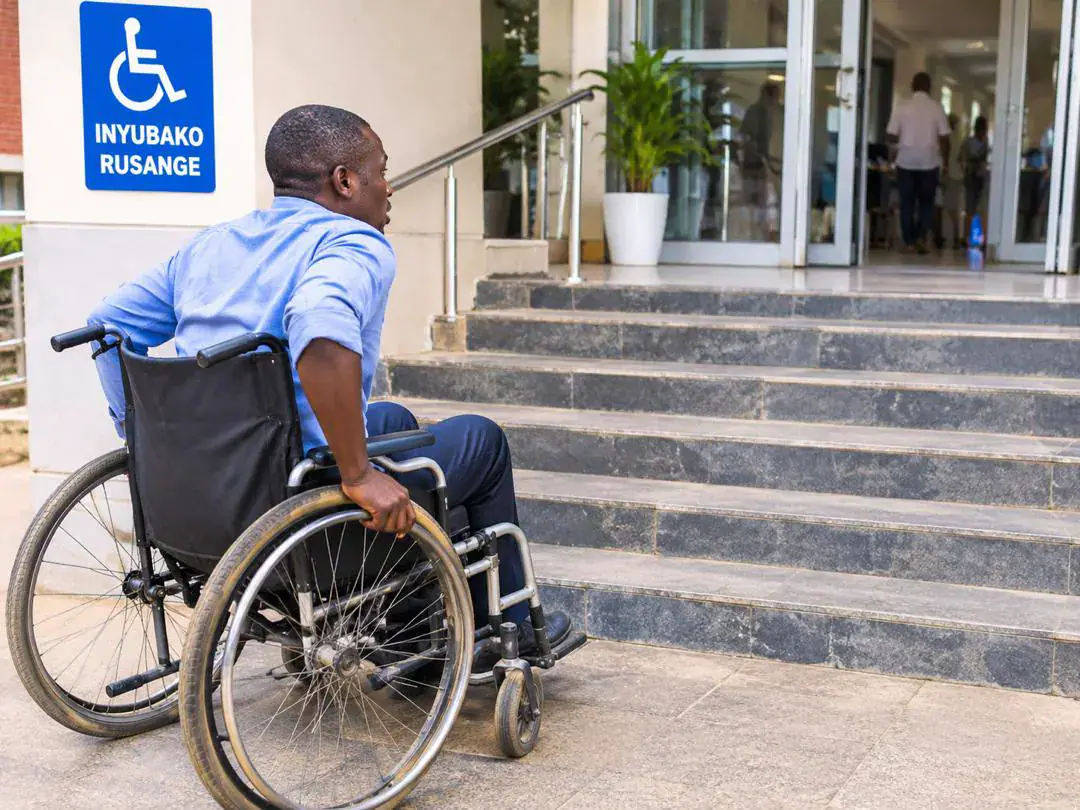
A recent survey conducted in Rwanda has revealed that a mere 38% of 30 public buildings inspected were found to be disability-friendly. The survey, carried out by the Association of People with Physical Disabilities in Rwanda (AGHR Rwanda) in collaboration with various stakeholders, assessed public buildings, including schools, hospitals, government offices, banks, financial institutions, recreational centers, bus stations, and markets.
People with physical disabilities in Rwanda face significant challenges accessing public services due to infrastructure barriers. They cited difficulties in accessing toilets, counters, and other facilities, which are often not designed with their needs in mind. Niyibigira Cyprien, a person with a physical disability, recounted instances where he was unable to use toilets in public buildings because they were not adapted for people with disabilities.
The survey also found that some public buildings had infrastructure intended to facilitate access for people with disabilities, but these were often not constructed to required standards. As a result, they do not provide the expected level of assistance. Uwamahoro Yvonne, another person with a physical disability, described encountering obstacles in accessing services in public buildings, citing long counters and high service desks as major hurdles.
Renzaho Faustin, Executive Director of AGHR Rwanda, attributed the problem to the fact that many buildings were constructed before accessibility regulations were put in place. He emphasized that there is no deadline set for building owners to make their properties disability-friendly, which perpetuates the challenge. Faustin called for new constructions to be inspected to ensure they meet accessibility requirements and for staff to be trained to monitor compliance.
The Executive Director of the Rwanda Engineers Association, Eng. Bayingana Innocent, identified a lack of awareness about disability accessibility requirements, inadequate expertise, and insufficient budget allocation as causes of the problem. He pledged that the Association would work with AGHR Rwanda to educate construction professionals on designing disability-friendly buildings.
Under Rwandan law, building owners can be penalized for failing to meet accessibility standards, including loss of operating licenses. Mujawimana Seraphine, CEO of AGHR Rwanda, stressed that people with disabilities must be involved in the planning and construction process to ensure that their needs are adequately addressed.
According to available data, Rwanda has a total of 391,775 people with disabilities, of whom 122,999 live with physical disabilities. The government and stakeholders are urged to take concrete steps to address these infrastructure barriers and promote inclusivity.
Key points
- Only 38% of inspected buildings in Rwanda were found to be disability-friendly.
- Infrastructure barriers pose significant challenges to people with physical disabilities accessing public services.
- Raising awareness and enforcing accessibility regulations can help address the problem.
Reporting sources
- Rwanda: 38% by’inyubako zasuzumwe ni zo zorohereza abafite ubumuga bw’ingingo · https://umuseke.rw/