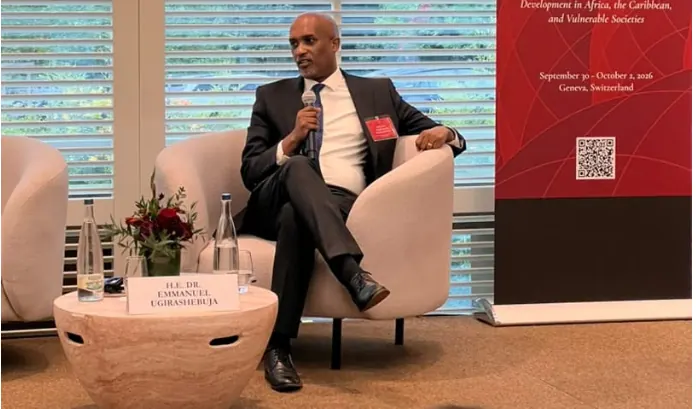
Rwanda's Minister of Justice and Attorney General, Emmanuel Ugirashebuja, has emphasized the need for Global South countries to have a voice in the development and governance of Artificial Intelligence (AI). Speaking at the Harvard High-Level Forum on AI and the Future of Development in Geneva, Switzerland, Ugirashebuja highlighted the importance of inclusivity in AI decision-making. He noted that while AI discussions often focus on technological advancements, safety, and security, they must also address accessibility, participation, and regulatory frameworks.
The Minister stressed that the Global South's concerns and priorities regarding AI differ significantly from those of developed nations. He warned that if not addressed, the global community might revert to a new form of development where innovations are driven by others, with regulations and intellectual property rights favoring external stakeholders. This could leave developing countries as mere consumers of technology, rather than active participants in shaping its future.
Ugirashebuja cautioned against extreme approaches to AI regulation, advocating for a balanced approach that fosters innovation while ensuring accountability. He emphasized that hasty adoption of AI without understanding its implications could lead to unforeseen problems, while overly restrictive regulations might hinder the benefits of AI for developing countries. The Minister called for a nuanced approach that promotes the development and expansion of AI, while ensuring that its use is just, transparent, and accountable.
The Harvard High-Level Forum on AI and the Future of Development brought together ministers, ambassadors, policymakers, researchers, and representatives from international organizations to discuss AI's role in development. The forum focused on the opportunities and challenges presented by AI and explored ways for countries, researchers, policymakers, and international organizations to collaborate on AI governance and regulation.
Ugirashebuja's remarks underscored the need for Global South countries to engage actively in AI-related discussions, ensuring that their perspectives and priorities are taken into account. He emphasized that AI governance must be a collective effort, with diverse stakeholders contributing to the development of regulatory frameworks and standards. This, he argued, would help prevent a situation where a few dominant players dictate the terms of AI development and deployment.
The Minister's call for inclusive AI governance reflects a broader concern about the potential for unequal access to AI benefits and the risks associated with its development. As AI continues to evolve and shape various aspects of society, it is essential that diverse voices are heard in discussions about its future. By engaging with international partners and stakeholders, Rwanda and other Global South countries can help shape a more equitable and sustainable AI landscape.
The forum in Geneva provided a platform for stakeholders to explore strategies for harnessing AI's potential while mitigating its risks. As AI becomes increasingly integral to development, it is crucial that countries work together to establish common standards and guidelines for its development and use. By doing so, they can ensure that AI contributes to sustainable development and benefits all nations, rather than exacerbating existing inequalities.
Key points
- Rwanda's Justice Minister emphasizes the need for Global South countries to have a voice in AI governance.
- Inclusive AI governance is crucial to prevent unequal access to AI benefits and risks.
- A balanced approach to AI regulation is necessary to foster innovation while ensuring accountability.