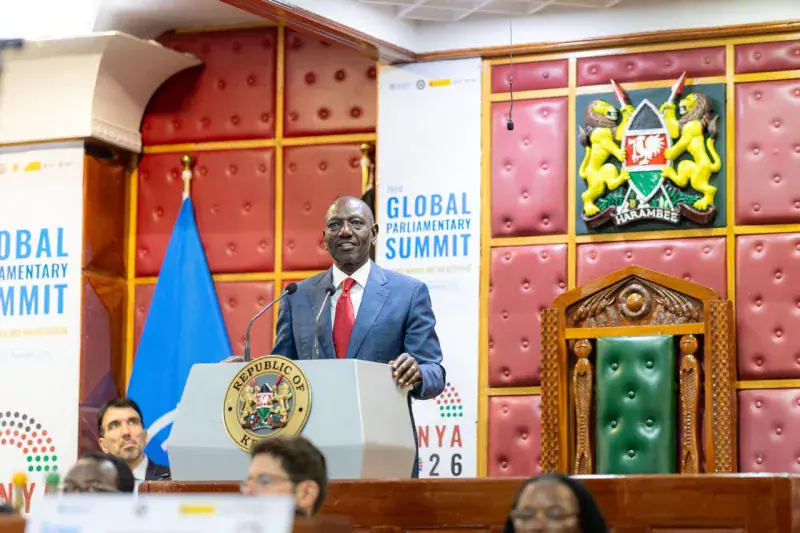
President William Ruto has challenged African parliaments to lead the fight against hunger and malnutrition. He emphasized that parliaments must enact legislation compelling governments to prioritize agricultural development through increased funding and infrastructure investment. Ruto made these remarks during the Third Global Parliamentary Summit against Hunger and Malnutrition at Parliament Buildings in Nairobi.
Ruto noted that despite progress in reducing global hunger, Africa continues to bear a disproportionate burden, with millions of people struggling to access adequate and nutritious food. According to a United Nations report released in July 2026, 645 million people globally experienced hunger in 2025, marking the third consecutive year of decline in the number of people affected. However, 309 million people in Africa experienced hunger, representing approximately one in every five people on the continent.
The President argued that Africa has the resources to become a major player in global food production, citing its more than 60 percent share of the world's remaining uncultivated arable land, youthful population, and vast renewable energy potential. He emphasized that Africa must be an indispensable part of the global solution to hunger. Ruto also noted that the continent's food insecurity challenge is not caused by a shortage of land or people willing to engage in agriculture, but by inadequate infrastructure, limited access to financing, and insufficient investment in modern farming technologies.
Ruto raised concern over Africa's dependence on imported food, stating that the continent spends approximately $100 billion annually importing food despite having significant agricultural potential. He also pointed to substantial post-harvest losses and the limited share of commercial lending directed towards agriculture, saying the situation undermines efforts to achieve food self-sufficiency. The President called for increased investment in local processing and value addition to strengthen agricultural value chains and create jobs.
The summit, jointly organized by the Parliament of Kenya, the Food and Agriculture Organization (FAO), and the Spanish Agency for International Development Cooperation (AECID), seeks to strengthen parliamentary action against hunger and malnutrition while advancing sustainable agrifood systems in support of the 2030 Agenda for Sustainable Development. The meeting brings together parliamentarians and other stakeholders to discuss legislative, budgetary, and oversight measures that can accelerate progress towards ending hunger and building climate-resilient food systems.
Ruto emphasized that parliaments have a responsibility to ensure governments prioritize agricultural financing, develop irrigation infrastructure, support farmers, and establish policies that encourage private sector participation in food production. He stressed that ending hunger requires legislation, budget, and oversight, which are fundamental responsibilities of parliaments. The President's call to action underscores the urgency of addressing food insecurity and malnutrition in Africa.
The Third Global Parliamentary Summit against Hunger and Malnutrition takes place amid growing concerns over climate change, food insecurity, and unsustainable agricultural production, which continue to threaten food systems and livelihoods across the world. The summit's theme, "Legislating for Resilient Agrifood Systems and Zero Hunger in a Changing Climate," reflects the need for legislative action to address these pressing issues.
Key points
- President Ruto calls on African parliaments to enact legislation compelling governments to prioritize agricultural development.
- Africa bears a disproportionate burden of global hunger, with 309 million people experiencing hunger in 2025.
- The continent spends approximately $100 billion annually importing food despite having significant agricultural potential.