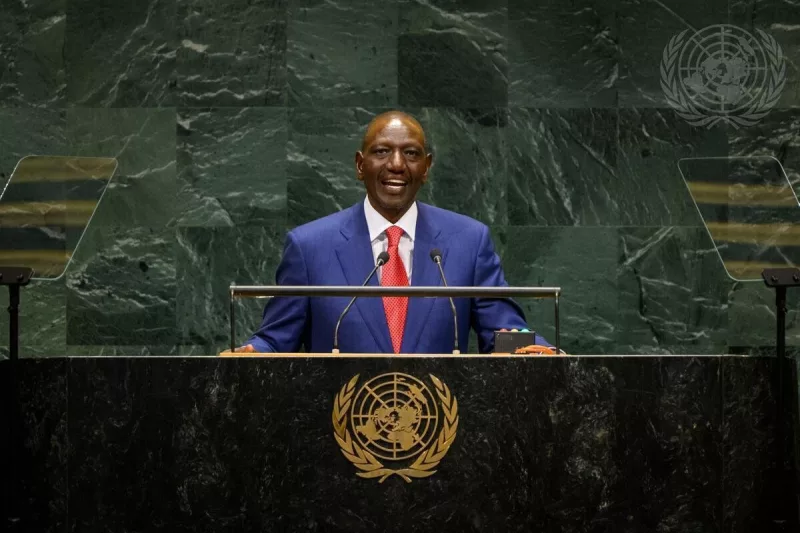
President William Ruto has urged Africa to shift its focus from exporting raw materials to building industries that add value locally. Speaking at the 81st Session of the United Nations General Assembly, Ruto emphasized that Africa has vast mineral wealth, immense agricultural potential, and significant renewable-energy resources. He noted that the continent's resources should be used to strengthen industries and contribute to addressing global challenges.
Ruto highlighted Africa's potential as a market of over 1.5 billion people, increasingly connected through the African Continental Free Trade Area. He stressed that Africa's resources must become the beginning of African industry, not the end of Africa's contribution to the value chain. The President cited examples of cocoa-producing countries moving from beans to brands and cotton producers building garment value chains.
Ruto announced plans to break ground on the East Africa refinery in Lamu within a week. The refinery will have the capacity to process 700,000 barrels of oil a day and represents an investment of approximately $16 billion. He emphasized that the project signifies the Africa that the continent seeks to build: adding value at home, creating jobs, and building industries capable of serving continental and global markets.
The President emphasized the need for financing to drive this transformation, citing over $4 trillion in domestic capital held in pension funds, insurance assets, sovereign wealth funds, banks, and other institutions across Africa. He called for mobilizing more of this capital for productive investment while building safeguards, credible projects, and financial instruments that long-term investors require.
Ruto also called for greater African representation in institutions that govern global finance. He noted that Africa's 54 countries are home to nearly one in every five people on Earth, yet the continent's influence in these institutions remains disproportionately small. The President emphasized that Africa is not seeking special treatment but proposes shared prosperity.
Ruto stressed that a more industrialized Africa would expand global demand, while a more food-secure Africa would strengthen global stability, and a better-connected continent would diversify global supply chains. He emphasized that Africa cannot carry substantial obligations under a system while remaining marginal in shaping its rules.
The President concluded that Africa must have a stake in the burden and a share in the decisions. He emphasized that this is not a plea for special treatment but a proposition for shared prosperity. Ruto's address highlighted the need for Africa to take a more proactive role in shaping its future and contributing to global development.
Key points
- President Ruto calls for Africa to shift from exporting raw materials to building industries that add value locally.
- The President announces plans to break ground on the East Africa refinery in Lamu, representing an investment of approximately $16 billion.
- Ruto emphasizes the need for greater African representation in institutions that govern global finance.