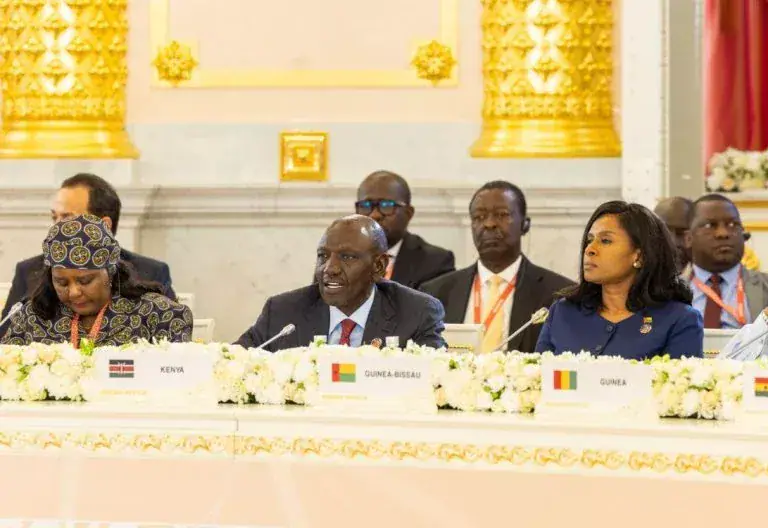
Kenyan President William Ruto has emphasized the need for stronger partnerships between Africa and Russia, focusing on creating jobs, transferring technology, and establishing industries on the continent. Speaking at the Third Russia-Africa Summit in Moscow, Ruto stated that Africa could no longer remain primarily a supplier of raw materials while importing finished products manufactured from its resources. He stressed the importance of African countries focusing on manufacturing, innovation, and value addition.
Ruto highlighted that African countries should focus on manufacturing, innovation, and value addition to increase the benefits they derive from their resources and expand their participation in the global economy. He stated that Africa was not seeking to withdraw from international trade but wanted to change the nature of its participation by entering into partnerships that strengthen local productive capacity. This approach would enable Africa to compete effectively in the global economy.
The President outlined that future partnerships would focus on setting up industries, transferring technology, developing skills, and creating jobs in Africa. Such partnerships, he noted, would benefit both Africa and Russia by creating new opportunities while supporting greater prosperity on the continent. Ruto emphasized that Africa's industrialization should not be viewed as a threat to other parts of the world.
Ruto invited Russia to work with African countries to build productive capacity, citing the African Continental Free Trade Area as an opportunity to develop industries and regional value chains. The agreement integrates a market of 1.4 billion people, providing the scale needed for competitive industries, expanded investment, and regional manufacturing. He identified agriculture as one of the immediate areas where Africa and Russia could deepen cooperation.
In the agricultural sector, Ruto called for collaboration in affordable fertilizers, local fertilizer manufacturing, agricultural mechanization, irrigation technology, research, and agro-processing. He emphasized that the goal was not merely to import more agricultural inputs but to build the capacity to produce them locally and strengthen food security across the continent.
Ruto also linked industrialization to climate responsibility, stating that Africa should be able to pursue economic development while addressing the effects of climate change. He cited Kenya's example, where industrialization and environmental responsibility were advancing together through investment in geothermal energy, green manufacturing, and climate-resilient infrastructure. The President called for greater investment in climate adaptation, early-warning systems, and drought-resilient agriculture.
The President concluded that Africa must not be made to choose between protecting the planet and lifting its people out of poverty. He emphasized that Africa's industrialization and climate responsibility should go hand-in-hand, and that investments should develop local industries and transfer technical expertise.
Key points
- Ruto calls for Africa-Russia partnerships to focus on job creation, technology transfer, and industry establishment.
- Africa's industrialization should not be viewed as a threat to other parts of the world.
- Kenya is demonstrating that industrialization and environmental responsibility can advance together.