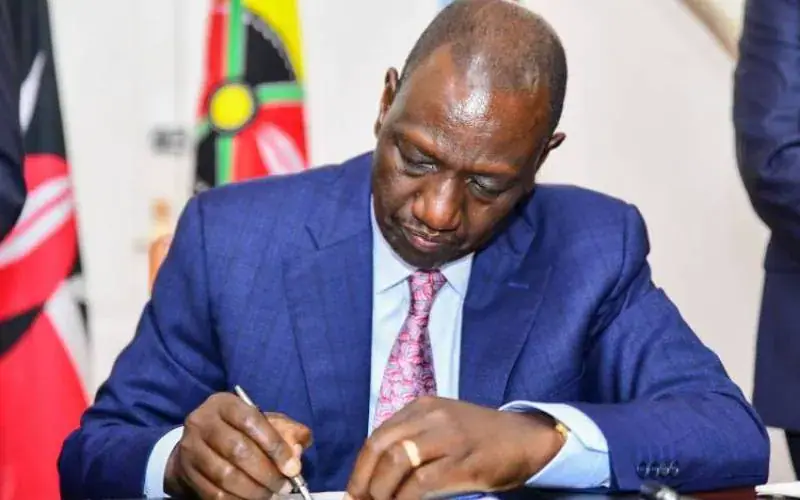
The Court of Appeal recently declined to suspend a High Court order requiring President William Ruto to reconstitute his Cabinet in line with Article 27(8) of the Constitution. This article stipulates that no appointive public body should have more than two-thirds of its members of one gender. The current Cabinet, comprising 25 members, has only seven women, falling short of the required nine.
The issue of gender balance in public appointments is not new. In 2012, the Supreme Court issued an advisory opinion stating that the two-thirds principle would be implemented progressively, with a deadline set for Parliament to enact enabling legislation by August 27, 2015. However, Parliament missed this deadline and an extension to 2016 also lapsed. Subsequent petitions were filed in the High Court, leading to an order for Parliament to act.
In 2020, the Chief Justice advised the President to dissolve Parliament due to its failure to address the gender imbalance. However, the High Court suspended this advice. This year, the High Court declined to dissolve Parliament on procedural grounds but reaffirmed the obligation to achieve gender balance. A three-judge bench declared the current Cabinet unconstitutional on June 30, 2026, citing that the rule is immediate, mandatory, and enforceable.
The court gave President Ruto 120 days to comply with the order, which expired on October 28. The Court of Appeal has since declined to suspend the order, leaving the President with no room for further delay. The Constitution is clear on this matter, and it is an obligation that the President has sworn to uphold. The implementation of this requirement does not necessitate new legislation, as Cabinet appointments fall within the President's power.
The Law Society of Kenya has stated that the current Cabinet is illegal, and its decisions are open to challenge. Further litigation, including contempt proceedings, is foreseeable and potentially avoidable if the President takes immediate action. The President's oath of office does not permit selective application of the law or waiting for court reminders of his duties.
Women deserve their rightful share in the Cabinet, and it is the President's responsibility to facilitate this. The Cabinet's reconstitution would not only address the legal challenge but also demonstrate leadership and commitment to upholding the Constitution. The public and various stakeholders are eagerly awaiting the President's response to this pressing issue.
The President's decision will have far-reaching implications, not only for the Cabinet but also for his administration's commitment to constitutional obligations. As the issue continues to unfold, stakeholders will be watching closely to see if President Ruto will take the necessary steps to ensure his Cabinet reflects the principles of gender balance enshrined in the Constitution.
Key points
- President Ruto's Cabinet must be reconstituted to include at least nine women to meet the constitutional requirement.
- The Court of Appeal has declined to suspend the High Court order, leaving the President with no room for further delay.
- The President's oath of office obliges him to uphold the Constitution, including the principle of gender balance in public appointments.