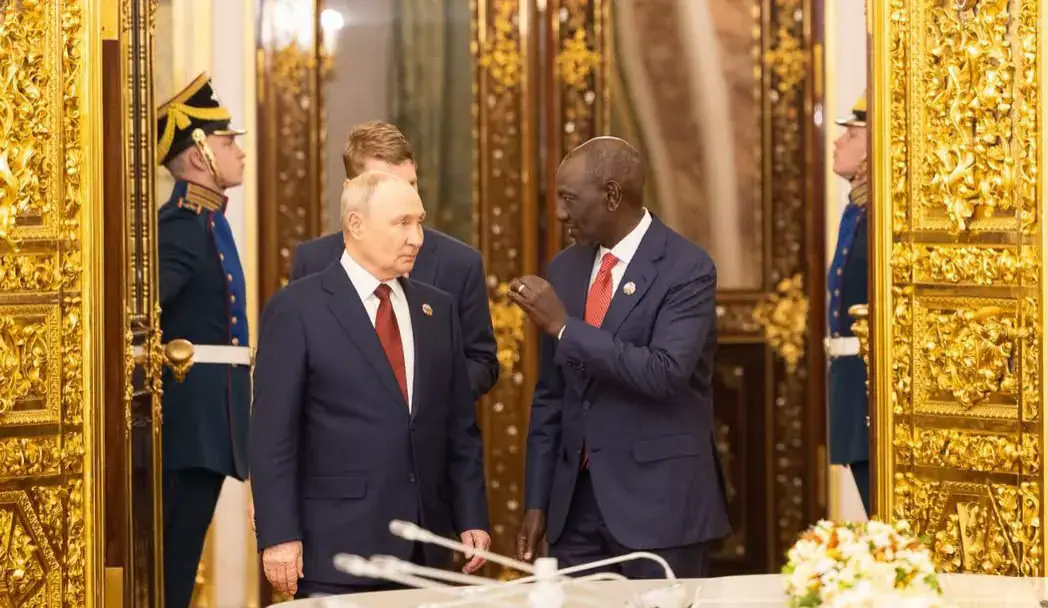
Kenyan President William Ruto announced on Friday, October 30, that Russia has agreed to categorize Kenya as a non-source country for recruitment into the Russian military. This development comes after Ruto's meeting with Russian President Vladimir Putin at the Kremlin in Moscow. The agreement aims to close a channel through which Kenyan citizens have been enlisted into Russia's armed forces amid the ongoing war against Ukraine.
Ruto also announced the appointment of a Defence Attaché at the Kenyan Embassy in Moscow. The official will work directly with Russia's Ministry of Defence to facilitate the return of Kenyans who travelled to Russia for military purposes. This move will also help process compensation for those affected. The Kenyan government has been under growing pressure to establish how its citizens were recruited and secure the return of those who want to come home.
According to the Kenyan government, 354 nationals are connected to the Russia-Ukraine conflict. This figure includes people reported to be on the front lines, in military camps, hospitalised, missing, killed, held as prisoners of war, or already returned to Kenya. As of the time of the report, 62 had been repatriated. An investigation by Journalists for Justice identified 841 Kenyans recruited into Russia's armed forces between May 2025 and February 2026.
The investigation also reported that at least 76 Kenyans had been confirmed dead by the end of June 2026. These findings have raised questions about recruitment networks and intermediaries who allegedly used promises of civilian employment to attract jobseekers before they became involved in military service. The circumstances of individual cases differ, and the reported figures do not necessarily represent every Kenyan who may have travelled to Russia or become involved in the conflict.
Beyond the military recruitment issue, Ruto and Putin discussed expanding educational opportunities for Kenyan students. The two countries will work to increase the number of Russian scholarships available to Kenyans from 70 to 300. The scholarships will cover areas including health, artificial intelligence, technology, aviation, and cybersecurity. This development aims to strengthen educational ties between the two countries.
Ruto and Putin also agreed to negotiate a bilateral labour agreement intended to allow Kenyans to live and work in Russia. The proposed arrangement could establish a formal framework for employment and labour cooperation between the countries. Additionally, Putin committed to supporting the expansion of the United Nations Office in Nairobi, which hosts major UN operations and serves as the organisation's principal headquarters in Africa.
During the Russia-Africa Summit, Kenya and Russia signed five cooperation instruments covering economic cooperation, labour inspection and employment promotion, transport, diplomatic training, and visa-free travel for holders of diplomatic and service passports. These agreements aim to strengthen economic and diplomatic relations between the two countries, with Kenya seeking to widen its economic relationship with Russia beyond existing trade.
Key points
- Russia has agreed to stop recruiting Kenyan citizens into its military following talks between Kenyan President William Ruto and Russian President Vladimir Putin.