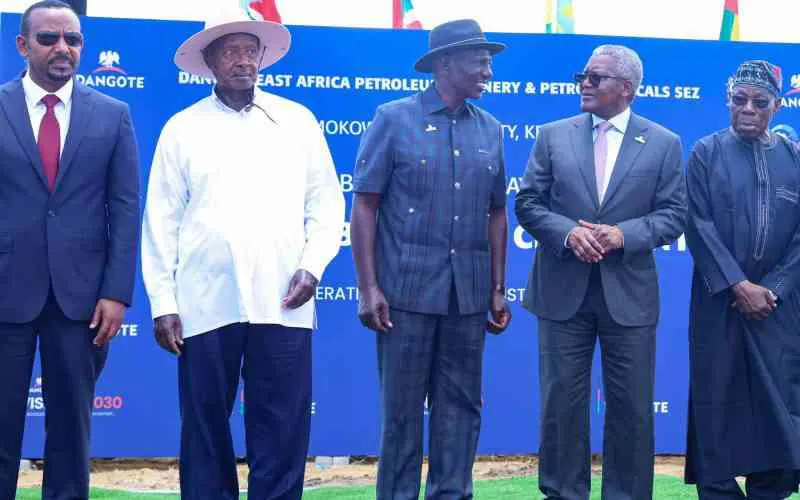
President William Ruto of Kenya has downplayed suggestions of rivalry between Kenya, Uganda, and Tanzania over competing refinery projects. He stated that East Africa's growing demand for petroleum products can support several facilities across the region. Ruto made these remarks during a media interview at State House Mombasa, a day after presiding over the groundbreaking of the Lamu refinery project.
The Lamu refinery project is a major component of a wider industrial complex on the Kenyan coast. Ruto said Kenya had no objection to Uganda and Tanzania pursuing their own refinery projects, arguing that the different facilities could complement rather than compete with one another. He mentioned that he had discussed Uganda's plans with President Yoweri Museveni and agreed that Kampala could proceed with a smaller refinery without threatening Kenya's investment in Lamu.
Ruto revealed that Kenya would even be prepared to buy petroleum products from Uganda if they could reach the Kenyan market at competitive prices. He cited the example of oil from Uganda being transported to Busia, saying, "If it is manufactured there in Uganda and the oil from that place is near Busia, and it can reach Busia at a lower price, we will buy oil from anywhere and bring it to Busia." This approach is expected to create a regional energy market where petroleum products can move across borders depending on availability, transport costs, and prices.
The President argued that the size of the regional petroleum market meant there was room for more than one refinery. He stated that the Lamu refinery would not be able to serve the entire region and would need to be expanded. Ruto also extended the same approach to Tanzania, saying Kenya could participate in a refinery project in Tanga if it is eventually developed. This, he believes, would strengthen economic cooperation within the East African Community.
Ruto said the Lamu refinery would address some of the challenges Kenya faces from dependence on imported refined petroleum products. He linked the proposed refinery to the need to reduce Kenya's exposure to international oil price shocks, disruptions caused by instability in oil-producing regions, and costs associated with transporting petroleum products over long distances. Local refining is expected to reduce expenses related to insurance and transportation while providing Kenya with greater access to locally processed fuel.
The government plans to develop industries around the Lamu refinery facility, including petrochemical, chemical, and plastics manufacturing. The refinery could also provide raw materials for industries producing fertilizer and bitumen, potentially reducing reliance on imports of some petroleum-based products. This broader development is expected to create opportunities for employment, investment, and trade while strengthening Lamu's position as an industrial and logistics center.
Ruto emphasized that Kenya's policy would be guided by competitiveness, allowing businesses and consumers to obtain petroleum products from whichever regional facility can supply them efficiently and at favorable prices. He maintained that Kenya, Uganda, and Tanzania do not need to view their refinery plans through the lens of rivalry. Instead, multiple facilities could create a larger and more integrated petroleum market capable of serving the needs of East Africa.
Key points
- President Ruto downplays rivalry between Kenya, Uganda, and Tanzania over oil refinery projects.
- Kenya open to buying petroleum products from Uganda and Tanzania if competitive prices are offered.
- Lamu refinery project expected to strengthen economic cooperation within the East African Community.