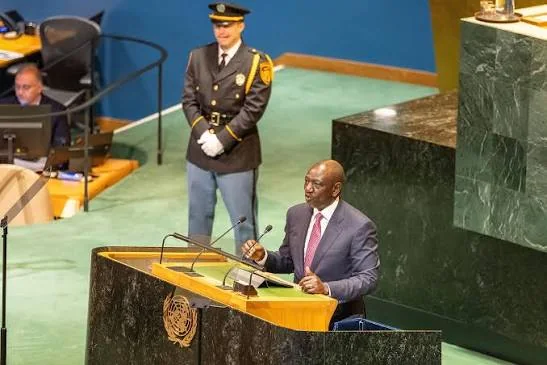
Kenyan President William Ruto addressed the 81st United Nations General Assembly in New York on September 23, 2026, where he defended the organisation's continued value. He pointed to the UN's record in peacekeeping and improving human welfare as evidence of its importance. Ruto cited several countries that went through political or armed conflict, including Namibia, Cambodia, Sierra Leone, Liberia, and Timor-Leste, where the UN played a key role in helping them recover from conflict and creating conditions for lasting peace.
President Ruto highlighted the UN's contribution to peacekeeping efforts, noting that more than two million peacekeepers have served under the UN flag since 1948, drawn from 125 countries. He said their contribution provided evidence that peace could be achieved and maintained through joint action by nations. The President also acknowledged the UN's work outside conflict zones, saying its wider system had contributed to better living conditions for people in many parts of the world.
According to Ruto, the UN has supported efforts that led to the eradication of smallpox, helped vaccinate generations of children, and supported the fight against hunger and disease. He added that the UN had also played a role in increasing access to education, clean water, and humanitarian assistance for communities facing difficult conditions. The President noted that since the year 2000, deaths among children under five have fallen by more than half.
UN estimates released in March 2026 indicate that deaths of children below five years had dropped by more than half since 2000. However, 4.9 million children still died before reaching the age of five in 2024. Ruto said such gains showed what could be achieved when countries chose to work together rather than act alone. He emphasised that multilateralism works when nations summon the will to make it work.
Despite the progress, President Ruto recognised shortcomings within the international body, saying its performance should not be discussed without acknowledging areas where it had failed to meet expectations. He noted that the UN has not fulfilled every promise of its charter. However, Ruto emphasised that without the UN, the world would have been poorer, more dangerous, and less free.
Ruto said support for the UN should therefore be matched by a willingness to examine the institution as it exists today and address the challenges it faces. He stressed that conviction in what the UN can be requires confronting what it has become. The President's speech highlighted the importance of the UN in maintaining global peace and promoting human welfare.
In conclusion, President Ruto's address to the UN General Assembly emphasised the significance of the organisation in promoting peace, security, and human development. He urged nations to work together to address the challenges facing the UN and to strengthen its role in promoting a more peaceful and equitable world.
Key points
- The UN has played a key role in peacekeeping efforts, with over two million peacekeepers serving under its flag since 1948.
- The organisation has contributed to significant improvements in human welfare, including the eradication of smallpox and a decline in child mortality rates.
- President Ruto acknowledged the UN's shortcomings but emphasised its importance in promoting global peace and human development.