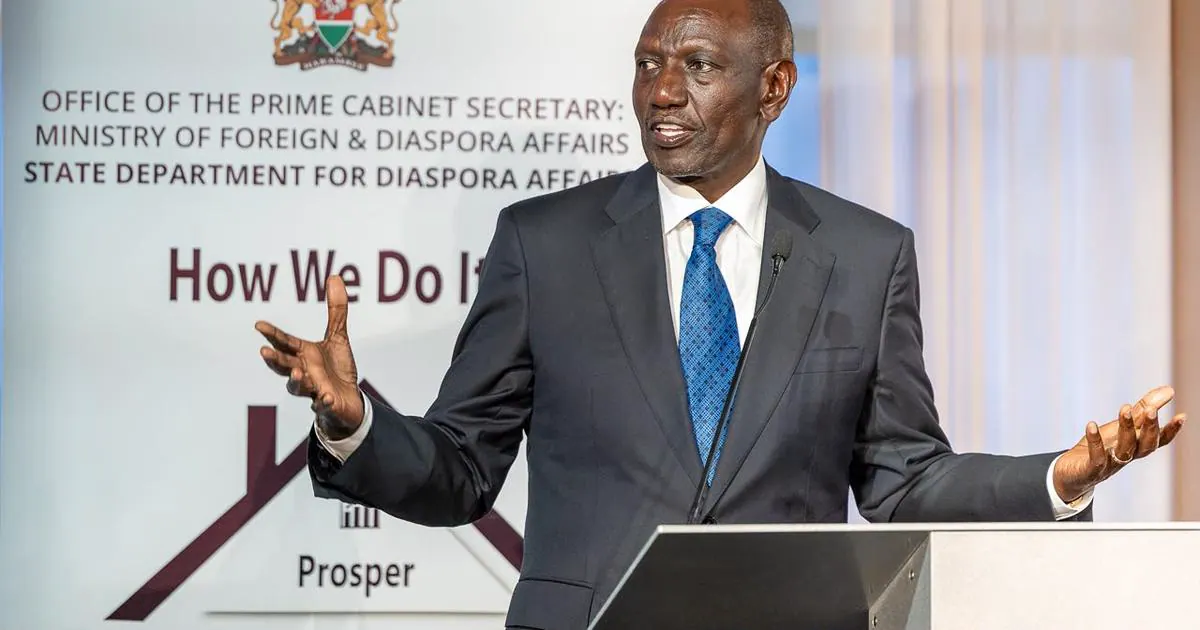
President William Ruto has challenged the assumption that Africa lacks sufficient funds to finance its development at the 81st session of the United Nations General Assembly. He argued that the capital exists but is often directed elsewhere due to financial rules. Ruto made this statement during the Africa We Build High-Level Roundtable on Regulation, Risk and Reward, held on the margins of the UNGA. The discussion included former Nigerian President Olusegun Obasanjo and UN Deputy Secretary-General Amina J. Mohammed.
According to President Ruto, African non-bank domestic capital pools have surpassed $2 trillion, while pension and insurance assets have crossed $1 trillion. In comparison, all external flows into Africa between 2014 and 2024 totalled about $1.7 trillion. Official development assistance to Africa has been declining since 2020, making African savings a larger source of potential development finance. The question remains as to why more of this money is not financing African infrastructure.
Ruto used the example of a teacher in Eldoret who contributed to a pension fund for two decades, but the savings may be invested in a Treasury bill rather than a productive project such as a nearby geothermal plant. Kenya's pension industry holds about Sh3.2 trillion, or roughly $24.7 billion, with 46 percent invested in government securities and only 0.02 percent in infrastructure debt. Ruto argued that the ceiling on pension fund investments in infrastructure is not the main obstacle.
President Ruto called for African risk to be priced against actual African default and recovery data, rather than methodologies that may not adequately reflect local experience. He cited a UNDP estimate that more objective ratings could save African countries as much as $74.5 billion. Ruto also called for cheaper insurance for productive assets and changes to prudential and liquidity rules that can make long-term African investments less attractive.
Ruto presented Kenya as a test case for changing how African risk is assessed, citing three favourable credit-rating actions since August 2025 and foreign-exchange reserves of about $15 billion. Kenya has also increased its equity investment in the Africa Finance Corporation by Sh3.25 billion and established an AFC regional office in Nairobi. The country's first infrastructure fund was listed on the Nairobi Securities Exchange in May, raising Sh3.4 billion.
The President further pointed to the National Infrastructure Fund, signed into law in March 2026, which aims to mobilise up to $40 billion for infrastructure without relying solely on new public debt. He proposed a working group to report back at the next Africa We Build Summit with findings based on numbers rather than a political communiqué. Ruto's goal is to make investing in productive African assets routine.
By 2050, Africa is expected to have a population approaching 2.5 billion, requiring massive expansion of power, transport and industrial systems. Ruto emphasised that Africa cannot finance this transformation one exceptional project at a time, but rather by making investing in productive African assets a standard practice.
Key points
- President Ruto argues that Africa has trillions in savings but struggles to finance its own infrastructure due to financial rules.
- African non-bank domestic capital pools have surpassed $2 trillion, while pension and insurance assets have crossed $1 trillion.
- Ruto proposes that African risk be priced against actual African default and recovery data to attract more investments.