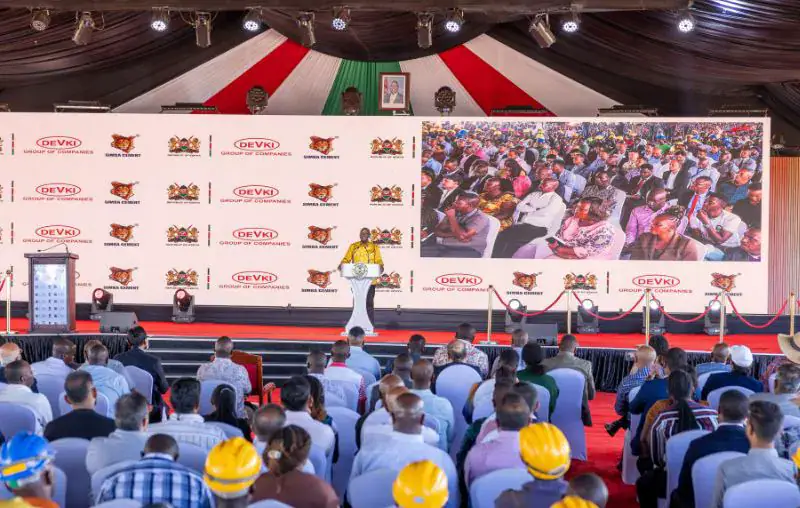
Kenyan President William Ruto has announced plans to break ground for a new Bamburi Cement clinker manufacturing plant in Matuga, Kwale County. The announcement was made during a groundbreaking ceremony for a Devki Group facility in Ngaaie, Kitui County, on October 27, 2026. The new plant is expected to boost local production of construction materials and reduce reliance on imports. Ruto stated that the groundbreaking for the Bamburi Cement plant will take place in about three weeks.
The proposed Matuga plant will have a capacity to produce 5,000 tonnes of clinker per day and 1.6 million tonnes annually. This will increase Bamburi Cement's annual clinker production capacity from one million tonnes to 2.6 million tonnes. The company's overall cement production capacity is anticipated to rise from 1.8 million tonnes to four million tonnes annually. This expansion will enable Bamburi to meet the growing demand from Kenya's construction sector.
Bamburi Cement has already committed to the project by signing a $250 million engineering, procurement, and construction contract with Chinese firm Sinoma CBMI Construction Co. Ltd. in December 2025. The ceremony was witnessed by President Ruto himself. The new facility is expected to create extensive job opportunities and stimulate local businesses. The project will also generate sustained employment during operations and unlock opportunities for local businesses.
The government has been working to encourage local production and attract investment into domestic manufacturing. In 2023, the Export and Investment Promotion Levy was introduced on imported clinker to promote local production. Ruto explained that manufacturing more clinker domestically will retain economic value within the country and facilitate technical skills development.
The Matuga project is expected to have a significant impact on Kenya's cement manufacturing industry. The government is working alongside private investors to ensure industrial projects result in jobs, stronger local enterprises, and increased economic activity. Ruto highlighted the government's responsibility to provide reliable infrastructure, efficient public services, and a predictable investment environment to support manufacturing growth.
The new plant will reduce Kenya's reliance on clinker imports, which has historically exposed local cement producers to volatile international supply costs and foreign exchange fluctuations. By producing more clinker domestically, the country can retain economic value and create sustainable employment opportunities. The project will also have a positive impact on the construction sector, which is driven by major infrastructure and housing projects.
President Ruto's announcement is part of the government's efforts to boost the manufacturing sector and create jobs. The project is expected to have a positive impact on the local economy and contribute to the country's economic growth. The government's collaboration with private investors is expected to lead to more industrial projects that will create jobs and stimulate economic activity.
Key points
- The new Bamburi Cement plant will have a capacity to produce 1.6 million tonnes of clinker annually.
- The project is expected to create extensive job opportunities and stimulate local businesses.
- The government introduced the Export and Investment Promotion Levy on imported clinker in 2023 to encourage local production.