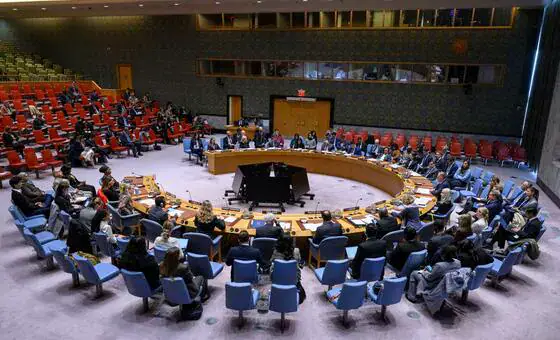
The recent veto by Russia on a US-proposed resolution regarding the Moroccan Sahara issue has sparked significant reaction on social media platforms. The move, which was made during a UN Security Council meeting on October 30, 2026, has been seen as a turning point in the decades-long dispute over the region. Many Moroccan activists have welcomed the development, stating that it marks the end of an era of "conflict management" and the beginning of a new phase in the country's struggle for sovereignty.
The Russian veto has been interpreted as a significant blow to the efforts of the UN's MINURSO mission, which has been tasked with overseeing a referendum in the region. The mission's mandate was set to expire, but the Russian veto has effectively put an end to the possibility of a referendum. This development has sparked a renewed debate about the future of the region and the role of the international community in resolving the dispute.
According to a statement released by the Royal Palace, Morocco is set to enter a new phase in the issue, one that will focus on strengthening international support for its autonomy initiative under Moroccan sovereignty. The move is seen as a significant shift in the country's approach to the issue, with many activists welcoming the end of what they see as a protracted and fruitless process.
Many Moroccan activists have taken to social media to express their support for the government's new approach. They argue that the country is not opposed to the UN, but rather to the continuation of a process that has yielded little results. They also stress that Morocco is committed to finding a solution that is in line with its sovereignty and territorial integrity.
The Russian veto has also sparked a wider debate about the role of international powers in the region. Some have argued that the move is a significant shift in the global balance of power, with Russia emerging as a key player in the region. Others have seen it as a blow to the US and its allies, who had been pushing for a resolution that would have maintained the status quo.
The developments have also sparked a reaction from the international community, with many countries and organizations weighing in on the issue. The African Union, for example, has called for calm and restraint, while also reaffirming its support for the UN's role in resolving the dispute.
As the situation continues to unfold, one thing is clear: the Russian veto has marked a significant turning point in the Moroccan Sahara issue. The country is set to enter a new phase, one that will be marked by a renewed focus on its autonomy initiative and a strengthened commitment to its sovereignty.
Key points
- Morocco to enter new phase in Sahara issue, focusing on autonomy initiative under Moroccan sovereignty.