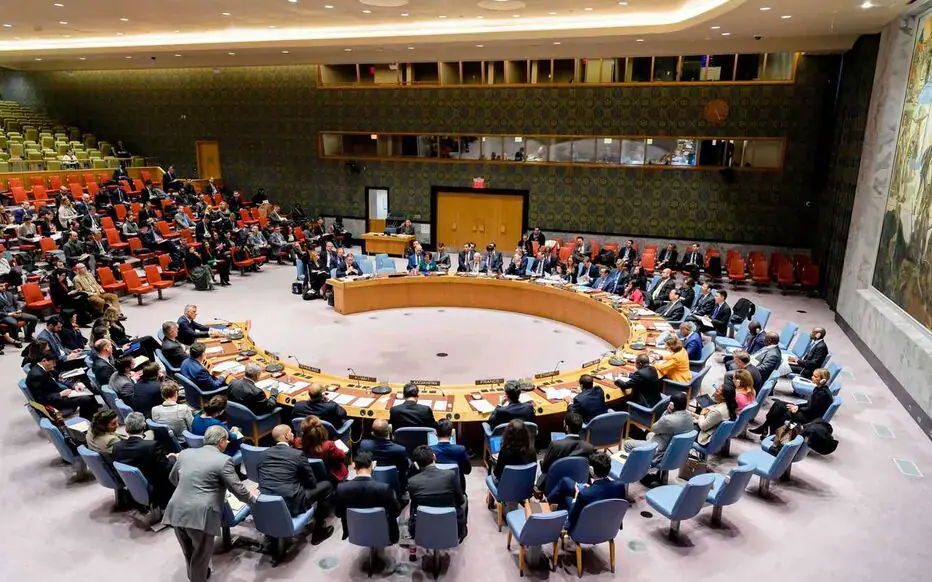
The UN Security Council experienced a dramatic turn of events on October 30, as Russia vetoed a US resolution to extend the mandate of the UN Mission for the Referendum in Western Sahara (Minurso) for another year. The resolution, supported by 11 of the 15 council members, would have placed the Moroccan autonomy plan at the center of negotiations to resolve the decades-long conflict between Rabat and the Polisario Front, backed by Algeria.
Moscow's veto, supported by China and Somalia, came as a surprise, especially after a recent meeting between Moroccan and Russian foreign ministers, Nasser Bourita and Sergey Lavrov. Russia's move was justified as a criticism of the "unilateral approach" of Washington. The Russian-proposed alternative, which would have renewed the Minurso mandate under its previous terms, failed to gain the necessary majority, with the US voting against it and 11 members abstaining.
The veto has plunged the future of Minurso into uncertainty and revealed the rivalries for influence around the Western Sahara issue. Russia's partnership with Algeria may be a factor in its decision, with Moscow seeking to preserve its interests in North Africa and challenge US supremacy. The move also highlights Russia's intention to maintain its capacity for influence in resolving the Western Sahara conflict.
The US ambassador to the UN, Mike Waltz, strongly denounced the Russian veto, lamenting that some council members continue to advocate for a referendum, which has not been organized by the UN in decades. In Rabat, the royal cabinet welcomed the failure to renew the Minurso mandate, seeing it as a "significant step towards the definitive closure of the Western Sahara file at the UN."
Algeria and the Polisario Front have expressed satisfaction with the Russian veto. Algerian representative to the UN, Amar Bendjama, thanked Moscow and other countries that rejected the US project, reaffirming his country's commitment to the right of the Sahrawi people to self-determination. The Polisario Front also welcomed the outcome, which has exposed deep international divisions over Western Sahara.
The expiration of the Minurso mandate has opened a new period of uncertainty for the UN process. The conflict between Rabat and the Polisario Front, backed by Algeria, has lasted for nearly half a century. The US, Russia, and other international players are vying for influence in the region, making a resolution to the conflict increasingly complex.
The Western Sahara issue remains a contentious and complex diplomatic challenge. The Moroccan autonomy plan, supported by the US, faces opposition from Algeria and the Polisario Front, which advocate for a referendum on independence. The Russian veto has highlighted the deep divisions within the international community and the challenges of finding a solution to the conflict.
Key points
- Russia vetoes US resolution supporting Moroccan autonomy plan for Western Sahara
- Move plunges future of UN Mission for Referendum in Western Sahara into uncertainty
- Expiration of Minurso mandate exposes deep international divisions over Western Sahara