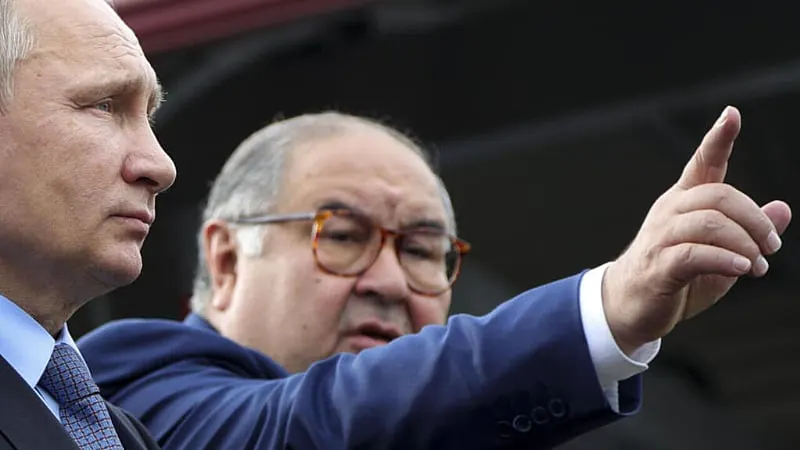
Russian dissident Vladimir Kara-Murza, who was freed in a major East-West prisoner exchange in August 2024, has expressed concerns over France's recent decision to lift sanctions on two Russian billionaires with close ties to President Vladimir Putin. In an interview with RFI in Paris, Kara-Murza stated that this move sends a "very dangerous signal" that the West is willing to go back to business as usual with Putin's regime. He emphasized that this decision is particularly alarming given the current situation in Ukraine.
Kara-Murza, who was arrested in Moscow in April 2022 and sentenced to 25 years imprisonment for treason and other charges, believes that Putin needs the war in Ukraine to remain in power. He stated that as long as Putin stays in power, the war will continue, and that there can be no end to the conflict while he remains in the Kremlin. Kara-Murza also highlighted the lack of democratic legitimacy in Russia, citing the absence of free elections and the government's total control over the media and political system.
The European Union had sanctioned Russian-Uzbek billionaire Alisher Usmanov, a metals tycoon with close ties to Putin, after Russia's full-scale invasion of Ukraine in February 2022. However, following a push from France, the EU removed him from its list on 22 September this year. Diplomats told news agency Reuters that France had come under pressure from Azerbaijan, which was holding French citizens – a claim Azerbaijan has denied. France also requested the removal of Russian billionaire Mikhail Fridman.
Kara-Murza criticized France's position, stating that it is "incomprehensible" and "shameful" that the French government did not ask for the release of some Russian political prisoners who could die tomorrow or next week. He also highlighted that there are currently more than 2,000 known political prisoners in Russia, compared to around 750 known political prisoners across the entire Soviet Union in the mid-1980s.
Kara-Murza's concerns are not limited to France, as he believes there is a broader trend towards thinking that countries can – and eventually will have to – talk to Putin. He cited the example of Canada, which has lifted sanctions against Anatoly Chubais, a former senior Kremlin official who left Russia after the 2022 invasion of Ukraine. Kara-Murza emphasized that appeasing an aggressor never leads to peace and that it only increases their appetite and ambitions.
Kara-Murza also expressed concerns about his own safety, given his status as an exiled Russian opposition figure. He stated that he doesn't think about it, but acknowledged that everyone knows the reality of Vladimir Putin's regime and the FSB. Kara-Murza was poisoned twice, in 2015 and 2017, and was given 25 years in prison.
The interview with Kara-Murza comes amid a backdrop of ongoing conflict in Ukraine and concerns about the West's response to Russia's actions. KEY_POINT: France's decision to lift sanctions on two Russian billionaires close to Putin sends a "dangerous signal" to the Kremlin. KEY_POINT: Kara-Murza believes that Putin needs the war in Ukraine to remain in power and that there can be no end to the conflict while he remains in the Kremlin. KEY_POINT: There are currently more than 2,000 known political prisoners in Russia.