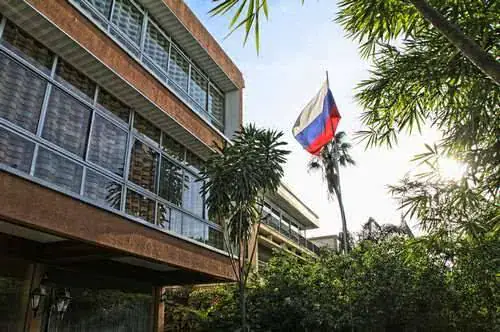
The Russian Embassy in Angola has announced that a new cultural center, dubbed the Center of Russian Science and Culture, will be inaugurated on December 1 in the Miramar area of Luanda. The center's opening is seen as a strategic move, with the location chosen for its proximity to other diplomatic missions, including those of the United States, Brazil, Côte d'Ivoire, Belgium, Ghana, and Ukraine. The center will be situated near the existing Russian Embassy and Consular Department.
The location of the cultural center holds symbolic significance, as it will be nestled among other diplomatic missions, allowing for easy access for the Russian community. The center's digital presence is already established, according to Alexander Bryantsev, the Russian Ambassador to Angola. The move is part of Russia's efforts to expand its cultural diplomacy globally, similar to other countries such as Portugal, Spain, and China, which have established their own cultural institutions.
This is not the first time Angola has hosted a Russian cultural center. Between 1970 and 1980, Luanda had a Soviet cultural center, which was closed in the 1990s following the collapse of the Soviet Union. The new center is part of Russia's efforts to re-establish its cultural presence in the region. The concept of cultural diplomacy, also known as "soft power," was coined by Joseph Nye, a professor at Harvard University, who identified culture, political values, and foreign policy as its key pillars.
The Russian cultural center in Angola will likely serve as a hub for promoting Russian culture, language, and values. The center's activities and programs will aim to foster greater understanding and cooperation between Russia and Angola. The Angolan government has not publicly commented on the center's establishment, but it is expected to strengthen ties between the two nations.
The inauguration of the cultural center on December 1 will feature the raising of the Russian flag in the Miramar area. The center's establishment is seen as a significant development in Russia's diplomatic efforts in the region. The move is also expected to enhance people-to-people exchanges between Russia and Angola, promoting greater cultural understanding and cooperation.
Russia's expansion of cultural centers globally is part of a broader effort to promote its interests and values. The use of cultural diplomacy as a tool of foreign policy has become increasingly popular in recent years, with many countries establishing cultural institutions abroad. The Russian cultural center in Angola is expected to play a significant role in promoting Russian culture and values in the region.
The establishment of the Russian cultural center in Angola has significant implications for the country's cultural and diplomatic landscape. The center is expected to promote greater cultural exchange and cooperation between Russia and Angola, and will likely serve as a model for future cultural institutions in the region. As the center begins its operations, it will be closely watched by diplomats, cultural experts, and the general public.
Key points
- The Russian cultural center in Angola will be inaugurated on December 1 in the Miramar area of Luanda.