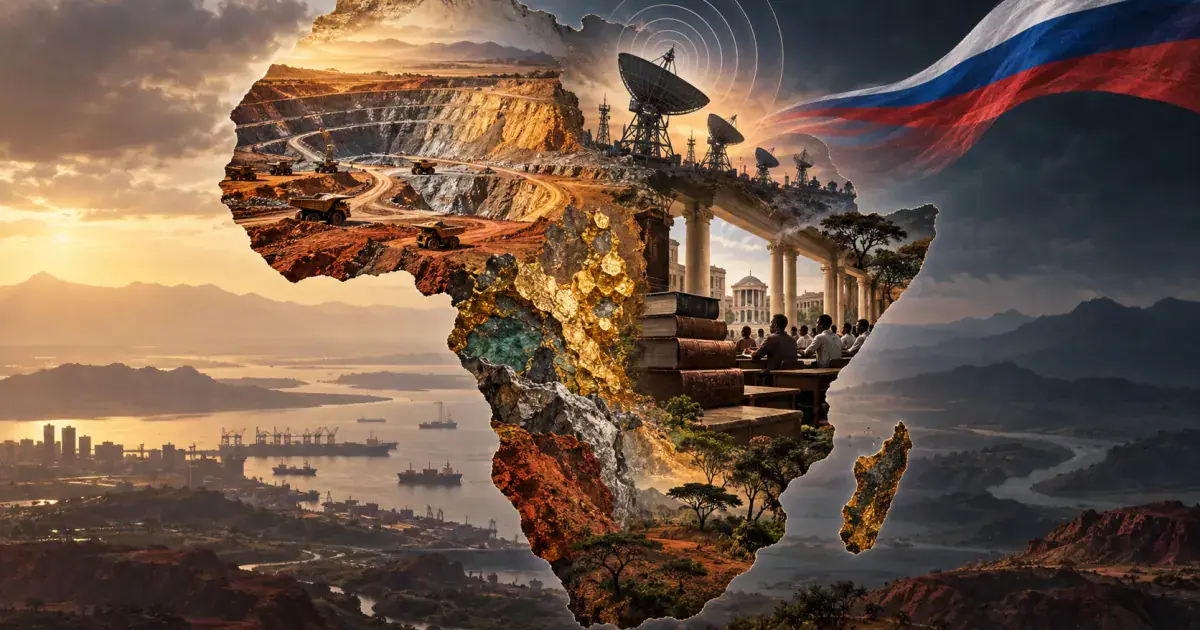
The third Russia-Africa summit, held in Moscow on October 28-29, 2026, highlighted Russia's ambitions to strengthen its economic and political positions on the continent. A confidential plan, revealed by Jeune Afrique, outlines Moscow's strategy to diversify its influence beyond the military sphere. The plan aims to increase access to natural resources, enhance media presence, and develop educational centers. This strategic move is part of Russia's efforts to establish itself as a major player in African affairs.
Russia's interest in Africa's natural resources is a key aspect of its strategy. The continent offers an abundance of uranium, gold, diamonds, hydrocarbons, and strategic minerals, which are crucial for Russia's economy, particularly in the face of Western sanctions imposed since the invasion of Ukraine in 2022. In several African countries, including the Central African Republic and Sudan, Russian mining interests have developed alongside security cooperation. This combination of military presence and economic activities demonstrates the complexity of Russia's engagement in Africa.
Moscow is also seeking to expand its media influence in Africa through partnerships between Russian and African media outlets, professional exchanges, and journalist training programs. This approach aims to promote Russia's perspective on international relations, emphasizing the challenge to Western dominance and the promotion of a multipolar world order. RT and Sputnik are key players in this media offensive, which has found fertile ground in countries where relations with former colonial powers are being reevaluated.
Education is another critical area where Russia is investing to secure its influence in Africa. The Kremlin plans to develop educational centers, university partnerships, and "Russian Houses," which promote the Russian language and culture. Currently, eleven Russian-supported centers for learning Russian are operating in Africa, with six located in Mali. Additionally, over 4,800 African students received university training quotas funded by the Russian federal budget in 2025. This educational investment is seen as a long-term diplomatic strategy.
Despite these ambitions, Russia's economic influence in Africa remains limited. The trade volume between Russia and Africa reached approximately $27.1 billion in 2025, falling short of Vladimir Putin's 2019 goal of $40 billion. The trade imbalance is significant, with Russia exporting $22.7 billion worth of goods to Africa and importing only $4.4 billion. However, Russia's military and diplomatic influence exceeds its economic footprint, particularly in the Sahel region.
The effectiveness of Russia's strategy in Africa is difficult to assess due to a lack of specific objectives and measurable targets. The plan's success hinges on various factors, including the number of new educational centers established, the financial commitments to media partnerships, and the investments made in natural resources. Without detailed budgets and timelines, it is challenging to distinguish between diplomatic commitments and concrete achievements.
As Russia continues to implement its strategy, African countries must evaluate the benefits of their partnerships with Moscow carefully. While diversifying international partnerships can enhance sovereignty, it does not automatically guarantee greater autonomy. African nations need to consider the implications of these partnerships, including the distribution of revenue from natural resources and the impact on local economies and industrial development.
Key points
- Russia's strategy in Africa includes expanding access to natural resources, enhancing media presence, and developing educational centers.
- The trade volume between Russia and Africa reached approximately $27.1 billion in 2025.
- Over 4,800 African students received university training quotas funded by the Russian federal budget in 2025.