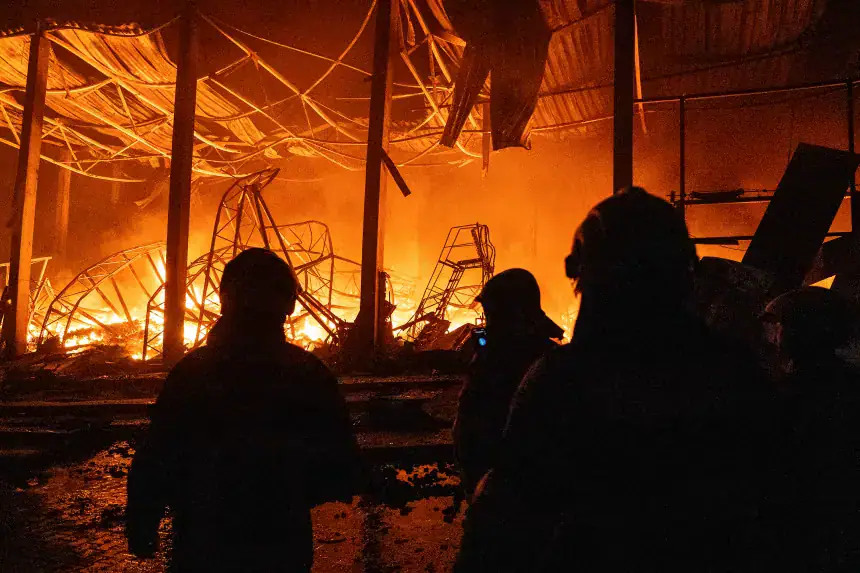
Russia has increased its aerial attacks on Ukraine, targeting the country's energy infrastructure, economy, and civilian population. Analysts say the Kremlin's strategy aims to damage Ukraine's economy and create a humanitarian crisis. An independent UN investigations panel concluded that Russia committed war crimes and crimes against humanity by intentionally attacking civilian infrastructure. This winter, experts warn that the situation is expected to be worse than previous years.
The Russian air campaign is now focused on destroying Ukraine's economy, according to John Lough, head of international partnerships at the New Eurasian Strategies Centre. Lough believes that many of Kyiv's European allies have not grasped the severity of the situation and the potential financial burden it could place on them. Putin has concluded that he cannot win in Donbas by committing more troops, so he is targeting Ukraine's economy in a systematic way.
The number of Russian strikes on Ukraine has increased steadily in 2026, with 3,650 strikes in January and 5,532 in October. Ukraine's Ministry of Defense reported that it hit at least seven enterprises involved in weapons production, three military airfields, and key radar and military communications facilities in October. Ukraine also launched attacks on Russia's largest online retailer, Wildberries.
Russian attacks have targeted Ukraine's Black Sea exports, Danube River ports, industrial warehouses, railway infrastructure, and steel industry. At least 55 Ukrainians were killed when Russia bombed a school building used as a shelter and aid center in Zaporizhzhia. Moscow denies targeting civilians. The city's steel plants were hit in ballistic missile strikes, forcing them to shut down and causing socio-economic consequences.
Experts say Russia's strategy appears to be an effort to create multiple economic firestorms across Ukraine's economy. Kateryna Stepanenko, Russia Team Lead at the Institute for the Study of War, noted that Russia is targeting things like malls, storages, and warehouses to disrupt the flow of goods and sales. Daytime strikes are also being used to upend day-to-day business activities in Ukraine.
The impacts of energy strikes are mounting, with many of Ukraine's power stations damaged beyond repair. Ukraine's capital, Kyiv, experienced a power blackout in October, and local authorities reported that roughly 40 percent of buildings didn't have heating. Overnight into Sunday, Russia attacked the power grid in the Dnipropetrovsk region, leaving more than 600,000 people without electricity.
Ukraine's foreign minister, Andrii Sybiha, warned that Moscow is deliberately seeking to leave millions of Ukrainians without electricity, heating, and water as winter approaches. The situation is expected to be dire, with Cristian Vlas, an Eastern Europe researcher at ACLED, predicting a terrible humanitarian situation this winter.
Key points
- Russia's attacks on Ukraine's energy infrastructure have left millions without electricity, heating, and water.
- The economic impacts of the war are mounting, with Ukraine's steel plants and other industries forced to shut down.
- Experts warn that the humanitarian situation in Ukraine is expected to worsen this winter.