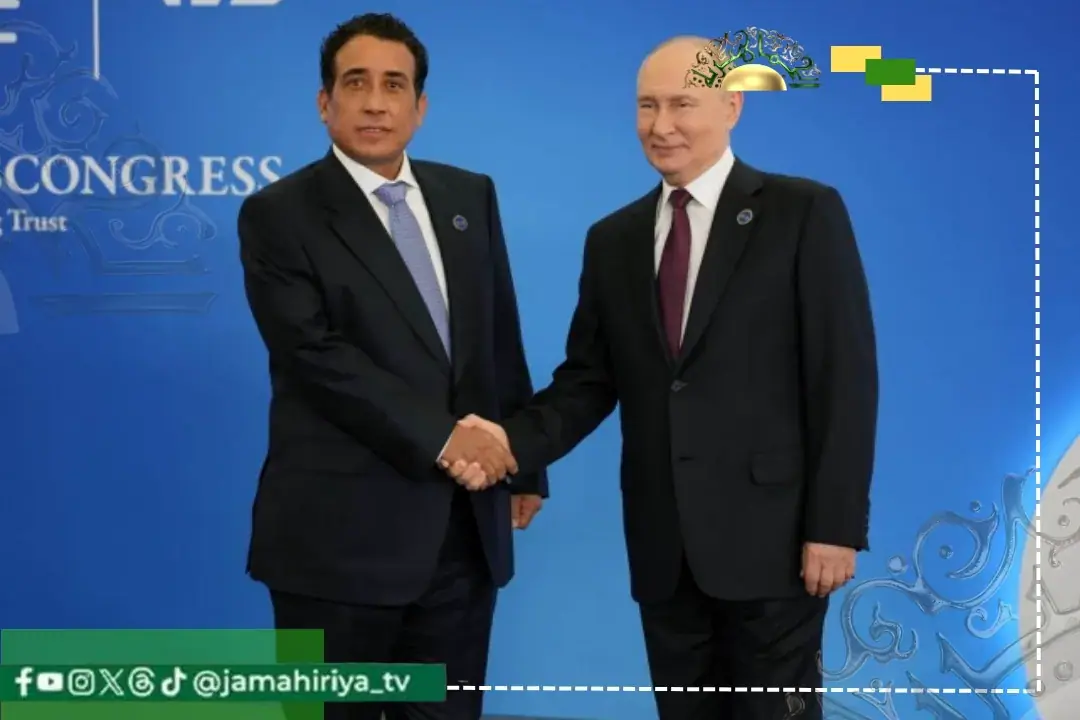
Russian President Vladimir Putin is working to establish a stronger political and economic presence in Libya, taking advantage of the country's continued divisions and disagreements over elections and resource management. According to a report by the Arab newspaper, Putin met with Libyan Presidential Council head Mohamed al-Menfi in Moscow on October 28, 2026, on the sidelines of the 8th Gas Exporting Countries Forum. During the meeting, Putin expressed Russia's support for Libya's unity, sovereignty, and national decision-making independence.
The Russian move aims to maintain a significant role in Libya's future settlement, not leaving the issue solely to UN mediation and Western initiatives. Russia's permanent membership in the UN Security Council and its relationships with Libyan parties support this goal. The Arab newspaper reported that Putin emphasized Russia's willingness to contribute to advancing the political process toward a consensual and sustainable solution, based on the principle of Libyan ownership.
The development comes amid ongoing disputes over the electoral process, including the legal and constitutional framework for elections, the formation of the High National Elections Commission, and the executive authority that will oversee the process. The agreement by the "4+4" mini-dialogue committee on August 30, 2026, to address electoral differences has faced varying positions between the House of Representatives and the High Council of State.
The political division is linked to disagreements over the management of economic institutions, particularly the Central Bank, oil revenues, and public spending. Continued differences on these issues may hinder the implementation of any political settlement and increase the difficulty of achieving financial stability. The Arab newspaper noted that Russia's discussions with Libya covered enhancing cooperation, reactivating the Libyan-Russian joint committee, and resuming Russian companies' participation in development and reconstruction projects.
Energy represents a crucial aspect of bilateral relations, as Libya needs investments and expertise to develop its oil and gas infrastructure, while Russia seeks to maintain relationships with energy-producing countries and strengthen its economic presence in North Africa. However, transforming understandings into practical projects remains tied to security stability, clear legal frameworks, and the ability of Libyan institutions to protect investments and ensure contract continuity.
The importance of Libya to Moscow extends beyond the energy sector to include its strategic location in the Mediterranean and connections to the African continent. The Arab newspaper stressed that expanding bilateral relations alone is insufficient to end the division and that the impact of Russia's move will depend on its contribution to a widely accepted Libyan settlement that supports institutional unity and stable resource management.
The ongoing competition for influence in Libya involves various international players. Russia's efforts to boost its presence in the country are part of a broader context of global interest in Libya's resources and strategic location. The situation in Libya remains complex, with multiple factors influencing the country's path toward stability and unity.
Key points
- Russia is working to strengthen its presence in Libya through support for the country's political process and investments in its energy sector.
- The ongoing divisions in Libya, including disagreements over elections and resource management, create opportunities for international players like Russia to increase their influence.
- The impact of Russia's engagement in Libya will depend on its ability to contribute to a stable and widely accepted political settlement.