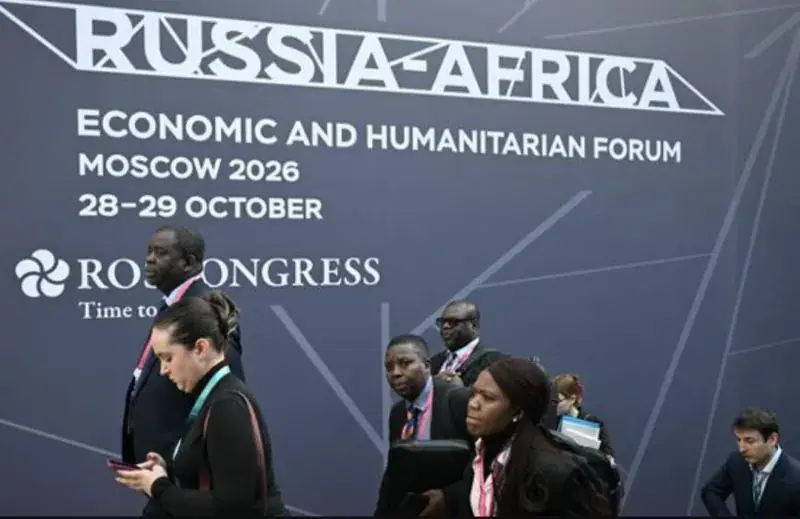
Representatives from Russian energy companies and ministers from African countries gathered for a session titled "Russia-Africa Energy Dialogue: Russian Technological Solutions for the Continent" at the Russia-Africa Forum. The discussion focused on energy justice, technological sovereignty, and specific projects, including floating nuclear power plants and hybrid solar centers. The session brought together officials from Russia's Ministry of Energy, Gazprom, NOVATEK, and Rosatom, among others, as well as ministers from Mali and the Central African Republic.
The session's moderator, Marina Kim, highlighted the demographic and economic stakes, citing UN forecasts that by 2050, one in four people will be African, and the continent's population will grow from 1.5 billion to 2.5 billion. Kim noted that Africa holds nearly a third of the world's natural resources, with much still untapped. This set the stage for discussions on long-term energy projects and cooperation between Russia and Africa.
Pavel Sorokin, Russia's First Deputy Minister of Energy, emphasized the importance of creating a dialogue platform for long-term projects, stressing that energy is a linchpin for all other sectors of the economy. He invited participants to anticipate needs over the next 15 to 20 years and highlighted Russia's readiness to develop both traditional and renewable energy sources in Africa, along with transport infrastructure and measurement systems.
Vitaly Markelov, a member of Gazprom's management committee, showcased the company's capabilities, including 28,000 billion cubic meters of reserves and 182,000 km of main gas pipelines. He stated that Gazprom is prepared to consider joint projects in areas such as hydrocarbon exploration, production, transport, and electricity generation. Markelov emphasized that Gazprom brings decades of accumulated knowledge, technology, and expertise to the table.
Philip Mshelbila, Secretary General of the Gas Exporting Countries Forum (GECF), drew attention to the scale of the energy poverty problem in Africa, where 18% of the global population lives but only 6% of global energy is consumed. He predicted that African demand for natural gas will double over the next 30 years and stressed that the continent needs not only technology but an entire ecosystem, including financing, licensing, and training.
Alusseni Sanou, Mali's Minister of Economy and Finance, thanked Russia for its support and highlighted the country's current energy capacity, which covers only 70% of its population's needs. Sanou expressed interest in developing a more balanced energy mix, including wind and solar power, and increasing the share of gas, uranium, and lithium. He emphasized the importance of on-site training for technical personnel.
The discussions showcased various projects, including NOVATEK's concept for an integrated energy hub based on a gravitational platform, which could serve as a hub for multiple countries. Unigreen Energy's Igor Shakhrai noted that Africa holds about 60% of the world's solar potential, with the continent adding around 17 GW of solar capacity in 2026. The costs of solar production in Africa have dropped significantly, making it an attractive market for the industry.
Key points
- Russia and Africa are exploring partnerships in energy, including nuclear and solar projects.
- The Russia-Africa Forum aims to strengthen cooperation between the two regions.
- Africa's energy demand is expected to grow significantly, with the population projected to reach nearly 1 billion by 2050.