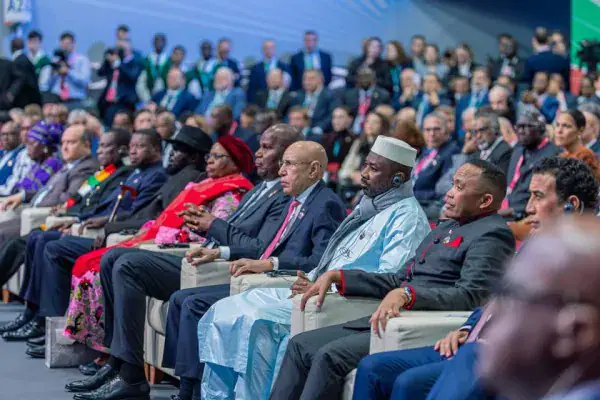
The Russia-Africa Economic and Humanitarian Forum has commenced in Moscow, marking a significant milestone in the relationship between Russia and the African continent. The plenary session, co-chaired by Russian President Vladimir Putin and Burundian President Évariste Ndayishimiye, who also leads the African Union, brought together representatives from nearly 50 African countries, including 22 heads of state and government. The forum aims to strengthen economic and humanitarian ties between Russia and Africa.
In his opening address, President Putin emphasized the need for a more just and multipolar world, where the voices of the majority are heard. He criticized what he termed as "neocolonial" tools, including trade wars, illegitimate sanctions, and Western attempts to keep Africa in a state of "debt slavery." Putin called for a deep reform of the International Monetary Fund (IMF) and the World Bank to serve the interests of developing economies. He also expressed ambition for Russia's economic ties with Africa, aiming for bilateral trade to exceed $50 billion.
President Putin highlighted over thirty energy projects underway in 16 African countries, as well as initiatives in medicine, vaccine production, laboratory and diagnostic center creation, agriculture, and transportation. He proposed establishing a Russia-Africa Youth Union, underscoring Russia's interest in developing relations with all African countries. Burundian President Évariste Ndayishimiye echoed Putin's sentiments, emphasizing Africa's aspiration to become a full-fledged actor in global transformation, rather than just a source of raw materials.
President Ndayishimiye invited Russian investors to engage more deeply with Africa, focusing on local resource transformation, environmental respect, and infrastructure development. He noted the potential of the BRICS platform for technology transfers and stressed the importance of concluding agreements that directly impact people's daily lives and reduce poverty. The Malian President, General Assimi Goïta, also present at the forum, seeks to strengthen African solidarities and consolidate ties with Moscow, particularly in defense, energy, mining, agriculture, and transportation.
The Malian government has signed two strategic contracts with Russian state-owned company Zarubezhgeologia, as part of efforts to enhance cooperation. The forum also saw discussions on a potential alliance between the Confederation of Sahel States (AES) and Russian financial institutions. Russian Vice-Premier Minister Alexandre Novak mentioned possible investment projects worth several billion dollars in Mali, Burkina Faso, and Niger.
On the sidelines of the forum, President Goïta met with his Congolese counterpart, Denis Sassou Nguesso, to discuss diplomacy, security, and geopolitics. A memorandum of partnership was signed between Russian media agencies and the African Media and Communication Association (AMAP). The forum is set to conclude with a final declaration, an action plan for 2027-2029, and a document on the civilian applications of artificial intelligence.
The Russia-Africa summit is expected to yield numerous agreements and a strengthened partnership between Russia and Africa. President Goïta's visit to Moscow was marked with official honors, reflecting the importance of the meeting. The outcomes of the forum are anticipated to have a lasting impact on Russia-Africa relations and global geopolitics.
Key points
- Russia aims to increase bilateral trade with Africa to over $50 billion.
- The Russia-Africa forum seeks to promote a multipolar world order and reform international financial institutions.
- African leaders are pushing for deeper cooperation with Russia in areas such as energy, mining, and infrastructure development.