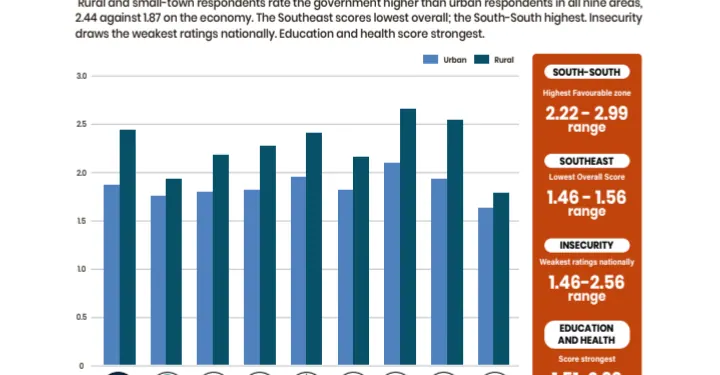
A recent survey by SBM Intelligence has revealed that rural Nigerians have a more positive perception of the economy compared to their urban counterparts. The survey, titled Nigeria 2027: A Narrower Race, gathered data from 1,103 eligible voters across 12 states and the Federal Capital Territory, representing all six geopolitical zones. The report found that rural and small town respondents rated the government's economic performance at an average of 2.44 out of four, compared with 1.87 among urban respondents.
The survey, conducted through face-to-face interviews in both urban and rural locations, recorded significant differences in ratings across various sectors, including health, education, and the economy. Rural respondents consistently rated the government higher than urban respondents in all nine areas measured in the survey. This disparity is notable, especially given that some major economic indicators have improved recently, with Nigeria's gross domestic product growing by 4.43 percent in the second quarter of 2026.
Despite the overall positive economic trends, the survey highlights that the improvement is not being experienced uniformly across the country. Petrol remains a significant concern for rural Nigerians, with 32.4 percent of rural respondents identifying it as a leading national problem, compared with 11.7 percent of urban respondents. In contrast, insecurity was the most cited concern in urban areas, at 34.5 percent. This difference reflects the distinct economic realities faced by rural and urban households.
The survey also found that rural respondents had a more positive view of President Bola Tinubu than those in urban areas. Tinubu recorded a net favourability rating of 22.5 percent among rural respondents, compared with a negative 16.4 percent among urban respondents, creating a 38.9 percentage point gap. This disparity in perception is mirrored in voting intentions, with the NDC recording 49.5 percent among urban respondents, compared with 20.9 percent for the APC.
In rural areas and small towns, the APC recorded 35.2 percent, while the NDC had 27.6 percent. The survey also identified differences in how both groups receive information, with social media used by 61.1 percent of urban respondents, compared with 29.6 percent of rural respondents. Radio use was higher among rural respondents at 23.1 percent, compared with 12.9 percent in urban areas.
Trust in the electoral process and intention to vote also varied between the two groups. Rural respondents expressed greater confidence in the Independent National Electoral Commission, with 66.8 percent expressing confidence, compared with 38.7 percent among urban respondents. Rural respondents also reported a higher intention to vote, with an average turnout score of 8.1 out of 10, compared with 7.65 in urban areas.
Despite these differences, the wider national mood has improved, with the share of respondents who believed Nigeria was moving in the wrong direction falling from 79.5 percent in the first wave to 56.8 percent in the second wave. The report linked this change to easing inflation, a stronger naira, and lower petrol prices. However, the improvement has not translated into broad satisfaction, with Nigerians described as being "less angry without becoming satisfied."
Key points
- Rural Nigerians have a more positive view of the economy than urban Nigerians.
- The survey highlights significant differences in perception between rural and urban respondents across various sectors.
- The improvement in economic indicators has not been experienced uniformly across the country.